


The SciNexic Files
Review
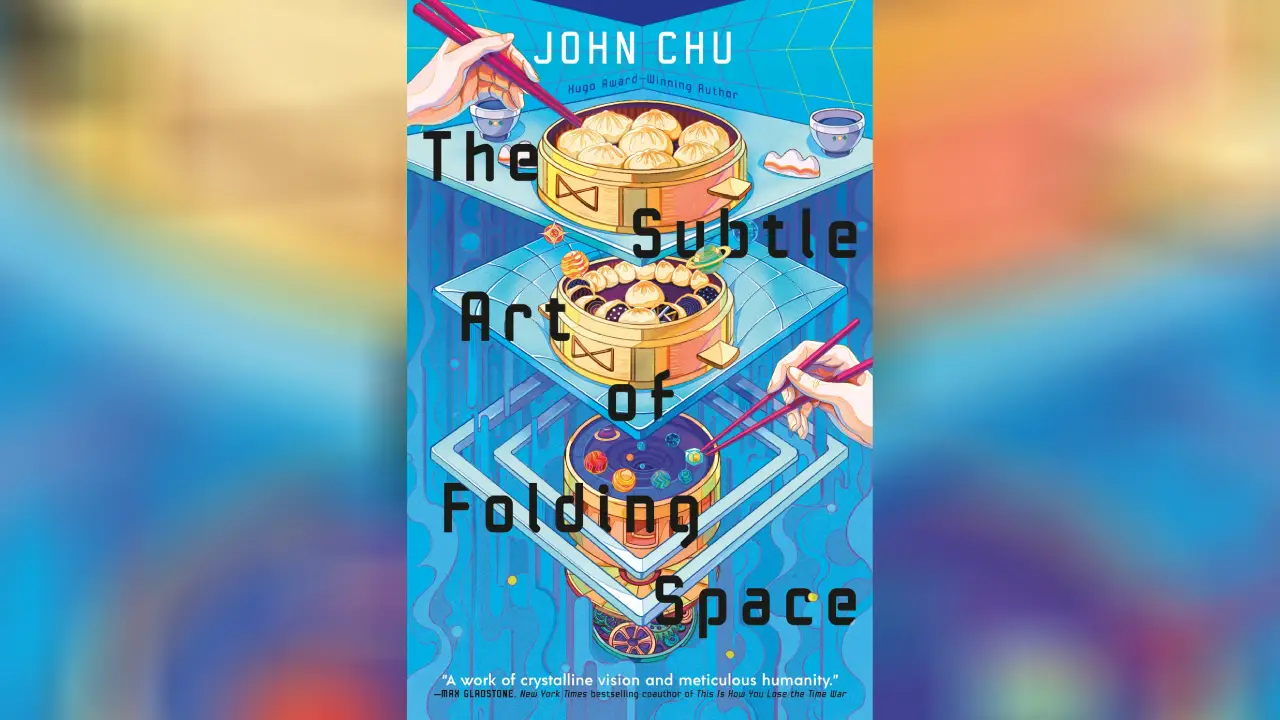
Space Sci-Fi Book of the Week: The Subtle Art of Folding Space by John Chu
The universe is breaking — but not in the usual space-opera way. There are no grand fleets carving up the galaxy, no alien empires looming over a battlefield, and no clean hyperspace jumps into the unknown. In John Chu’s The Subtle Art of Folding Space, reality itself has infrastructure. Physics can be maintained, patched, hacked and destabilised. And at the centre of that cosmic malfunction is a family already close to collapse.
Published by Tor Books on April 7, 2026, The Subtle Art of Folding Space is Chu’s debut science-fiction novel, though he is far from a newcomer to the genre. Chu is a Hugo and Nebula Award-winning author whose short fiction has appeared in venues including Uncanny, Clarkesworld, Asimov’s Science Fiction and Tor.com. With this novel, he expands his talent for intimate, high-concept storytelling into a compact but ambitious story about multiverse engineering, generational trauma and the price of keeping someone alive when reality wants to correct itself.
A Universe Held Together by Hidden Machinery
At the heart of the novel is Ellie, a woman whose personal life is already under impossible strain. Her mother is in a coma. Her sister Chris is caught up in danger, assassination attempts and family conflict. Meanwhile, a group of engineers is trying to hijack the skunkworks — the hidden system that keeps each universe’s physics operating as it should.
Then Ellie’s cousin Daniel discovers an illicit device inside the skunkworks. It appears to be keeping Ellie’s mother alive, but it may also be creating destabilising bugs in the physics of the universe.
Chu takes a familiar science-fiction question — how far should we go to save one person? — and turns it into something stranger, more technical and more intimate. The stakes are cosmic, but the pressure point is painfully personal.
Where Quantum Physics Becomes Family Drama
The most distinctive idea in the book is the skunkworks itself. Rather than treating physics as a fixed and distant set of laws, Chu imagines it as something built and maintained. The universe has systems. Those systems have workers. And, like any complicated system, they can be misused.
This gives the novel a very different texture from traditional space opera. The “folding” of space is not presented as a smooth cinematic jump from one star system to another. It is messy, dangerous and bound up with maintenance, error and consequence. The universe can glitch. A fix can create new problems. A hidden shortcut can become a threat.
That makes the book’s central metaphor especially effective. Ellie’s family is also a system full of hidden mechanisms, inherited damage and unstable pressure points. The same story that asks how reality holds together also asks how families hold together — and what happens when both begin to fail at once.
John Chu’s Strength: Big Ideas with Human Weight
Calling The Subtle Art of Folding Space “high-concept” is accurate, but it does not quite capture what makes the book interesting. Chu’s premise is full of quantum strangeness and multiverse machinery, but the novel’s emotional centre is grief, obligation and family dysfunction.
That is where Chu’s background in short fiction shows. His award-winning stories have often combined speculative ideas with deeply human consequences. Here, he brings that same instinct to a larger canvas. The book is not interested in cosmic scale for its own sake. Its best ideas matter because they place emotional choices under impossible pressure.
Ellie is not simply trying to solve a physics problem. She is trying to navigate a family crisis that has become entangled with the machinery of existence.
Not Traditional Space Opera — and Better for It
Readers expecting starship battles or a military campaign should adjust their expectations. The Subtle Art of Folding Space belongs more to the lineage of intimate, idea-driven speculative fiction than to straightforward galactic adventure.
That does not make it small. In fact, its scale is enormous. It simply reaches that scale through different means. Instead of focusing on empires and fleets, Chu focuses on the hidden architecture of reality. Instead of asking who controls the galaxy, he asks who maintains the rules that let a galaxy exist in the first place.
Why It Stands Out in 2026
April 2026 is a strong month for space science fiction, especially with James S. A. Corey’s The Faith of Beasts, the second book in The Captive’s War, arriving the same month. But the comparison highlights just how different Chu’s novel is.
Where Corey offers large-scale alien empire space opera, Chu offers a compact, emotionally charged puzzle box about family, physics and reality maintenance. One looks outward at conquest, captivity and interstellar power. The other looks inward, toward grief, obligation and the fragile systems — personal and cosmic — that keep life from collapsing.
That contrast is part of what makes The Subtle Art of Folding Space worth attention. It proves that space sci-fi does not have to be vast in page count or militaristic in structure to feel expansive.
Definitely a Worthy Read
The Subtle Art of Folding Space is a strange, thoughtful and emotionally grounded science-fiction debut. It blends multiverse mechanics, family trauma and cosmic instability into a story that feels both intellectually playful and personally urgent.
This is space sci-fi as metaphysical family drama: a book about what we owe to the people we love, what we risk when we refuse to let go, and what happens when the universe itself starts showing the cracks. Sometimes the most interesting frontier is not a planet or a star system, but the hidden mechanism that makes the universe what it is.
Which 2026 space-sci-fi book has moved you the most so far? Share your pick in the comments.
Further Reading and Official Links
Official publisher page: The Subtle Art of Folding Space — Tor Publishing Group
Macmillan book page: The Subtle Art of Folding Space — Macmillan
John Chu’s Profile Page and Bibliography
Related 2026 space opera release: The Faith of Beasts by James S. A. Corey — Hachette Book Group
For more space sci-fi book reviews, recommendations, and the latest in interstellar storytelling, keep exploring Scinexic.com
Get the SciNexic Dispatch
Space sci-fi news, reviews, trailers, and release picks—straight to your inbox.
Get the dispatch


Banner Image - The Subtle Art of Folding Space cover image - torpublishinggroup.com/the-subtle-art-of-folding-space/?isbn=9781250425409&=&format=hardback - Copyright: Macmillan