


The SciNexic Files
The SciNexic Files
The SciNexic Files
Article
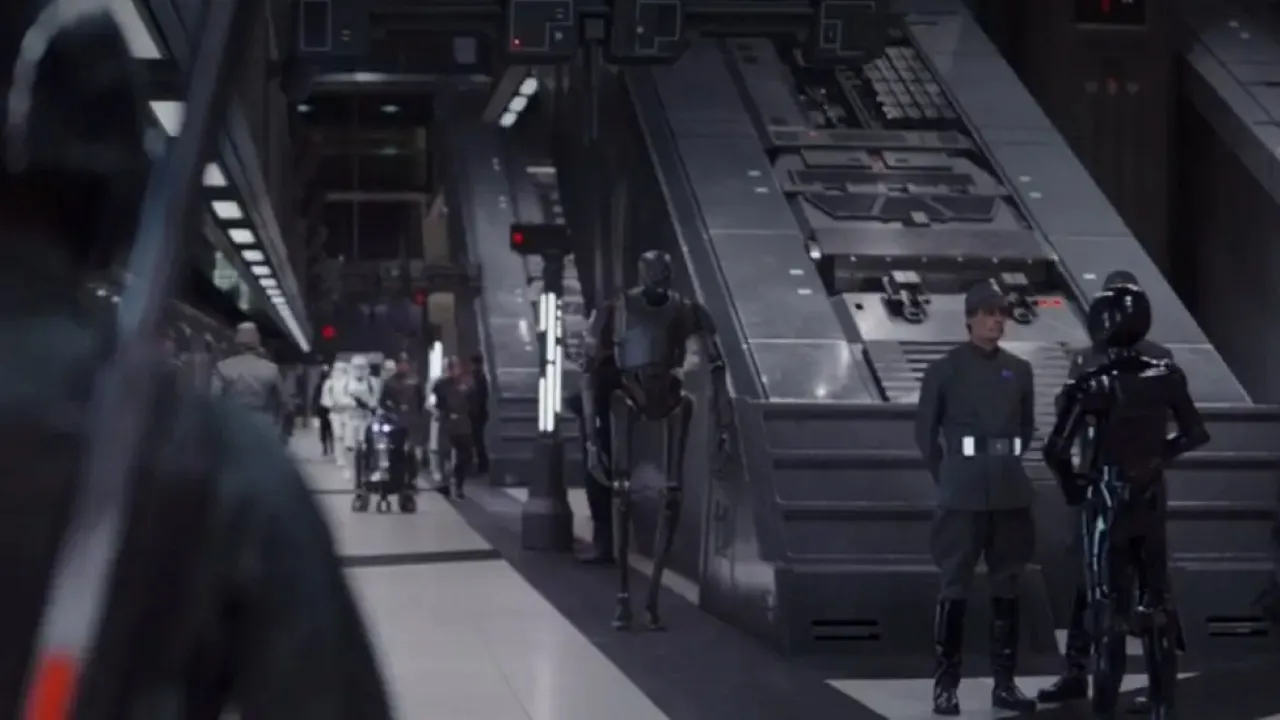
5 Real-World Buildings That Became Iconic Space Sci-Fi Sets
Space sci-fi loves impossible architecture: Senate plazas, corporate temples, alien colonies and imperial bunkers built to make humanity feel tiny. Yet some of the genre’s most convincing futures were not born in a VFX suite. They were found in real buildings — museums, transport hubs, civic centres and abandoned palaces whose architecture already looked halfway to another century.
Here are five real-world buildings that helped well-known space sci-fi titles feel larger, stranger and more believable.
1. Ciudad de las Artes y las Ciencias — Andor and Coruscant’s upper levels
Valencia’s Ciudad de las Artes y las Ciencias was designed principally by Spanish architect Santiago Calatrava, with Félix Candela also associated with the Oceanogràfic. Its white ribs, skeletal vaults, reflecting pools and operatic scale have long made it a gift to science fiction.
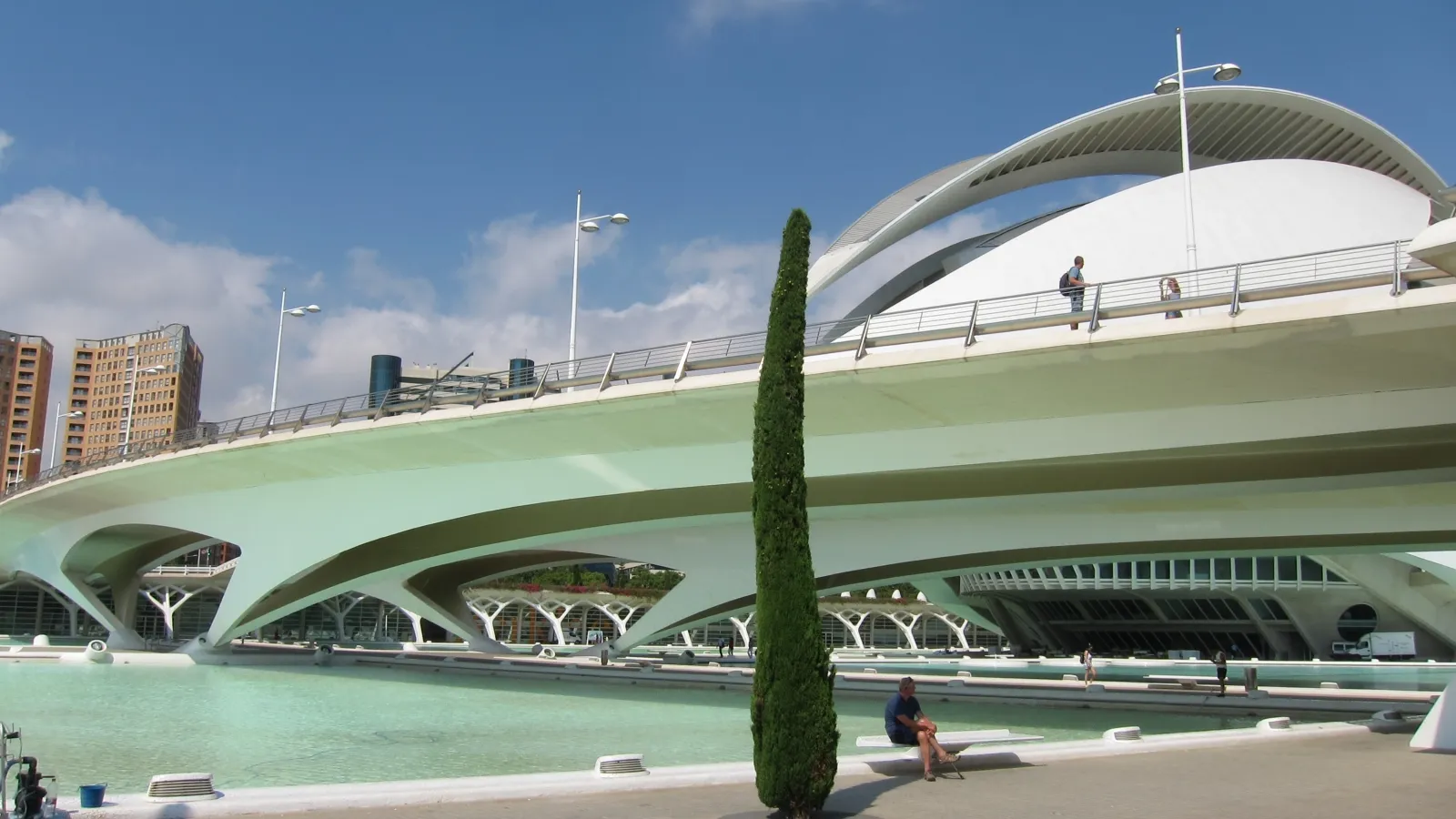
Andor Season 2 filmed multiple Senate sequences across the complex’s underpasses and colonnaded walkways. Image credit: Carlos Cunha/Wikimedia
For Andor Season 2, the complex became part of Coruscant, the political heart of the Empire. Spanish outlet Las Provincias reported that Lucasfilm used the site for the series and quoted creator Tony Gilroy calling Valencia “incredibly valuable” and “absolutely amazing”. Executive producer Luke Hull described its architecture as something the team could integrate to represent “the upper part of Coruscant”.
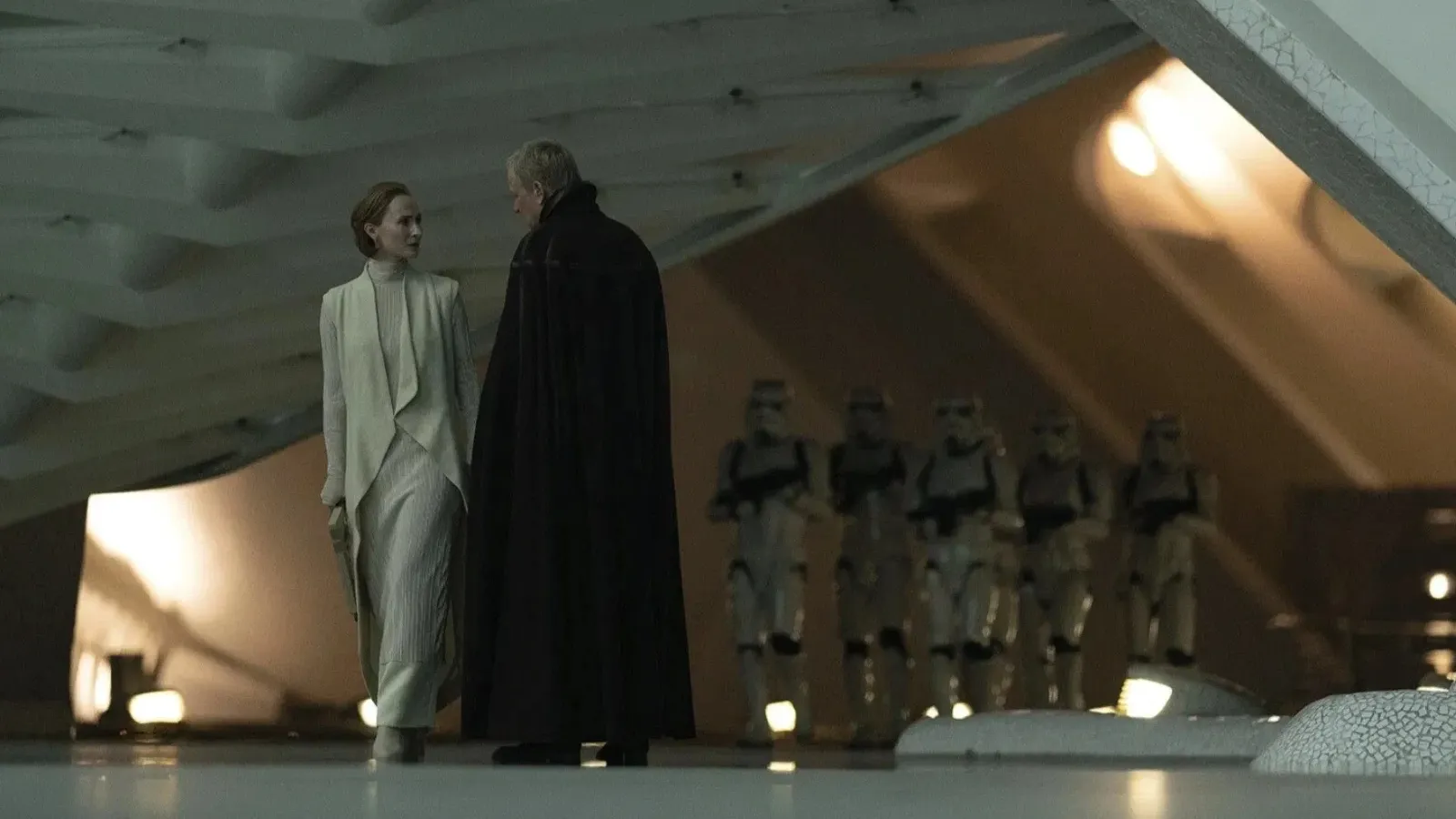
Mon Mothma (Genevieve O'Reilly) and Luthen (Stellan Skarsgård) during a swift, discreet meeting in one of the complex's elaborate covered walkways. Image credit: TMDB
Why does it work? Because Calatrava’s architecture is both utopian and faintly authoritarian: clean, monumental, ceremonial. It looks like a future that has polished away its dirt — perfect for Andor’s portrait of imperial power hiding brutality beneath elegance.
Trivia: the same Valencia complex has also appeared in Tomorrowland, Doctor Who and Westworld, according to Spain Screen Tourism.
2. Canary Wharf Underground Station — Rogue One: A Star Wars Story
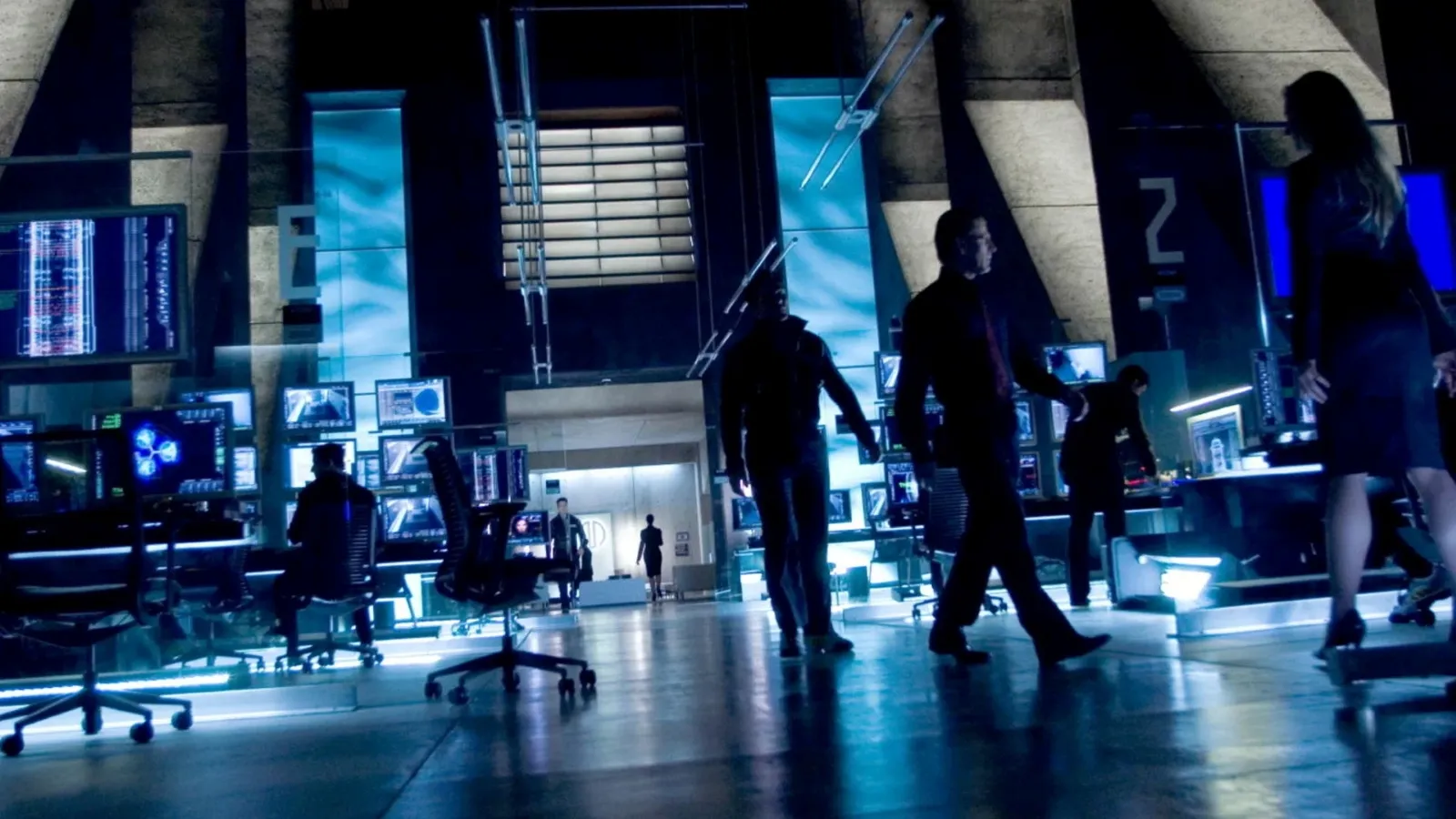
Few London commuters expect to pass through the Empire on the Jubilee line. But Canary Wharf Underground Station, designed by Foster + Partners under Norman Foster, became the interior of the Imperial Security Complex on Scarif in Rogue One.
The Worldwide Guide to Movie Locations notes that the Scarif security-complex scenes with Jyn Erso, Cassian Andor and K-2SO were filmed at Canary Wharf Tube Station, with shooting reportedly squeezed into the narrow overnight window when the Underground was closed. The station’s cavernous escalators, dark metal surfaces, glass canopies and disciplined symmetry needed surprisingly little persuasion to become Imperial infrastructure.
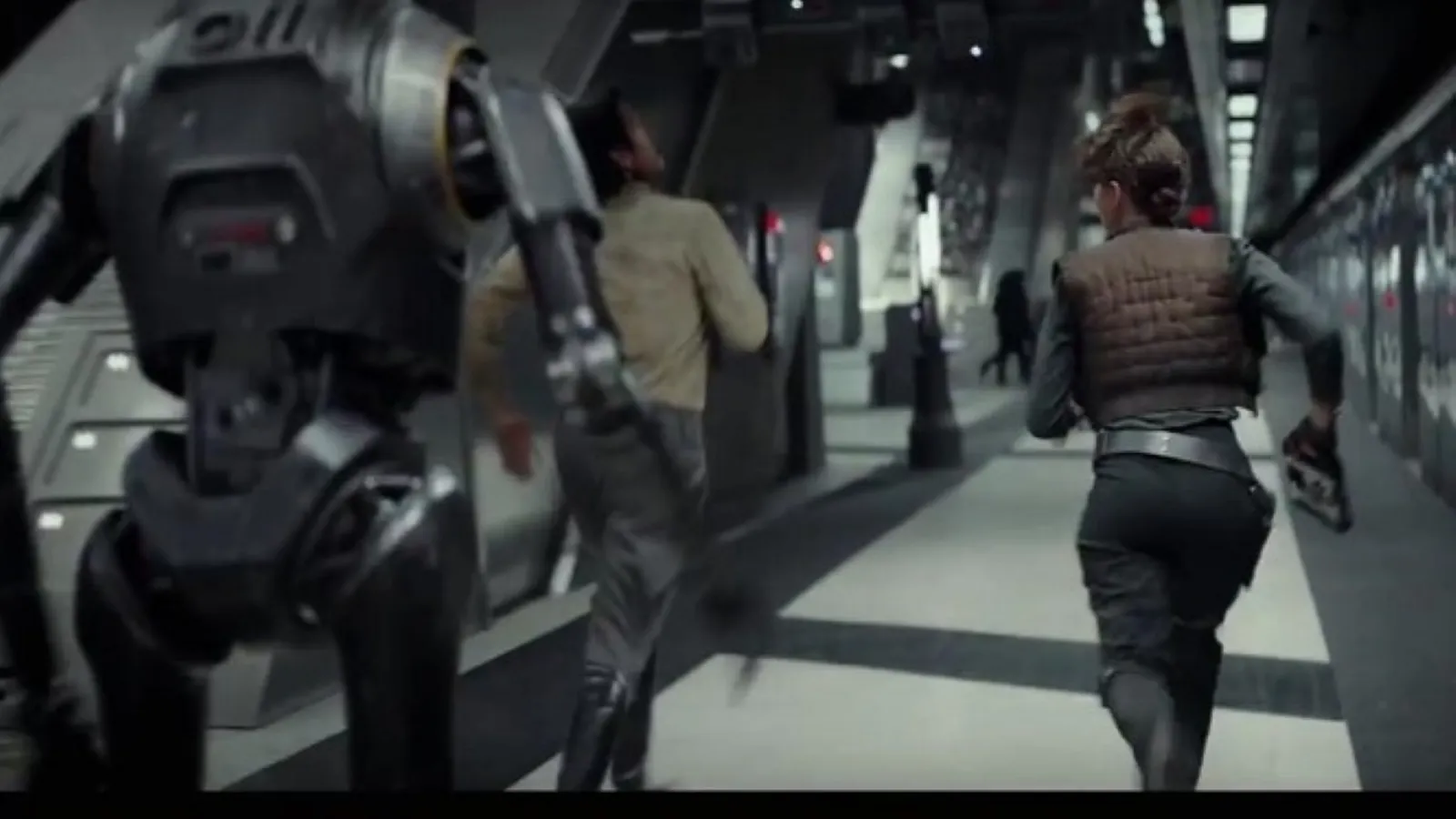
Scene image of Canary Warf Underground Station as Scarif, the Imperial base where the Death Star schematics were stored. Image credit: LucasFilm-Disney/Londonist.com
Director Gareth Edwards’ attachment to the place is wonderfully personal. According to MyLondon, he recalled thinking of Canary Wharf:
“This is something from the future. This is like a sci-fi movie. If I ever get to do a sci-fi film in my life, I’m going to film it here.”
He did. The result is one of modern Star Wars’ most satisfying location steals: public transport transformed into military bureaucracy.
3. Budapest Stock Exchange Palace — Blade Runner 2049
Not all futuristic architecture is shiny. Sometimes the future is old, hollowed out and haunted.
In Denis Villeneuve’s Blade Runner 2049, the former Budapest Stock Exchange Palace became the decaying Las Vegas casino where Officer K finally finds Rick Deckard. The building, also known as the Exchange Palace, was originally built in 1905 and designed by Hungarian architect Ignác Alpár.
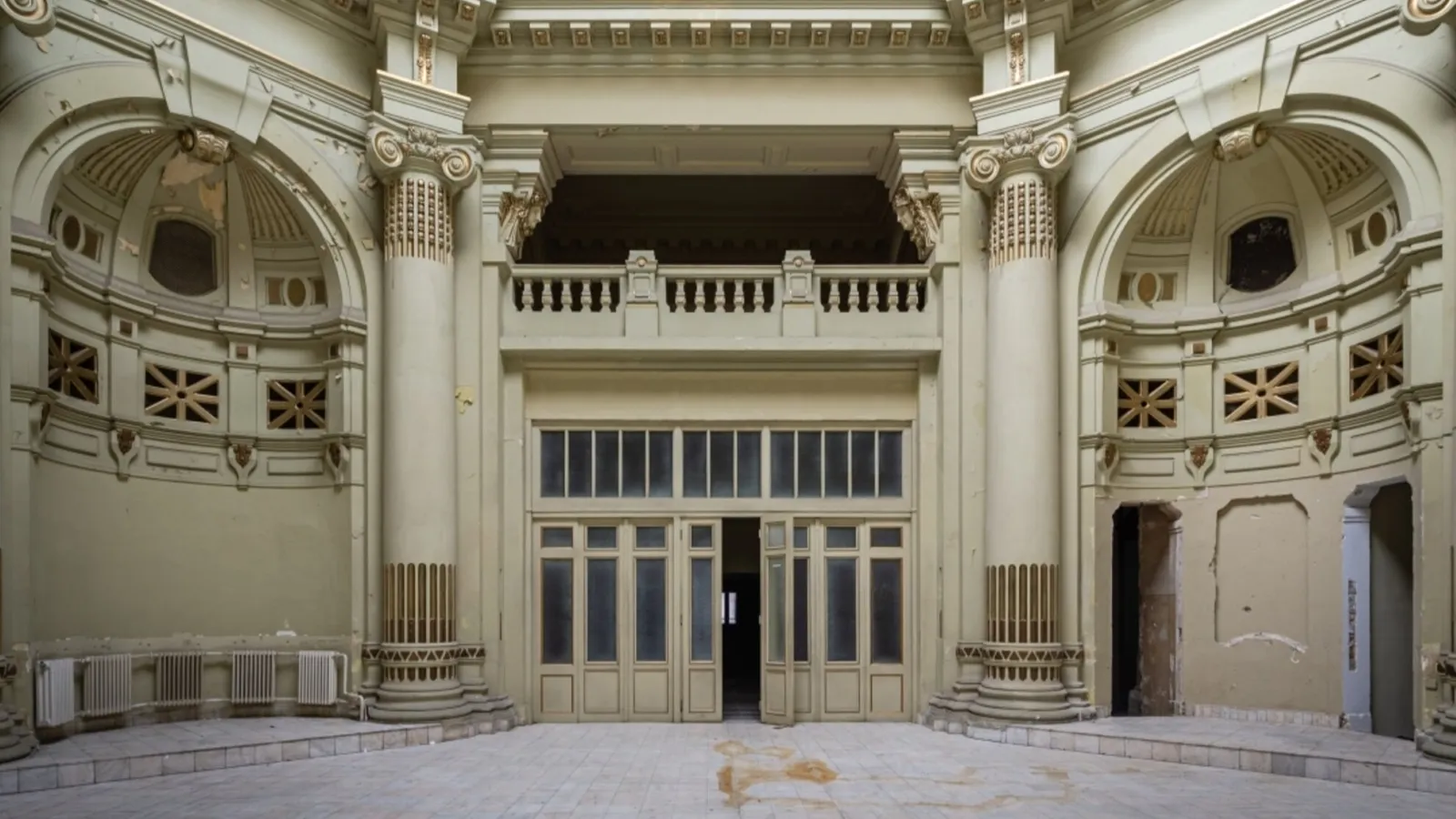
The Palace’s classical ornamentation and lavish interior fits seamlessly into Blade Runner 2049’s moody, dystopian future. Image credit: Pataki Tamás/WeloveBudapest.com
Location database Sceen It identifies it as the Blade Runner 2049 location for K’s search for Deckard, while We Love Budapest also adds that the historic Stock Exchange Building at Szabadság Square was used for the “Vintage Casino”.
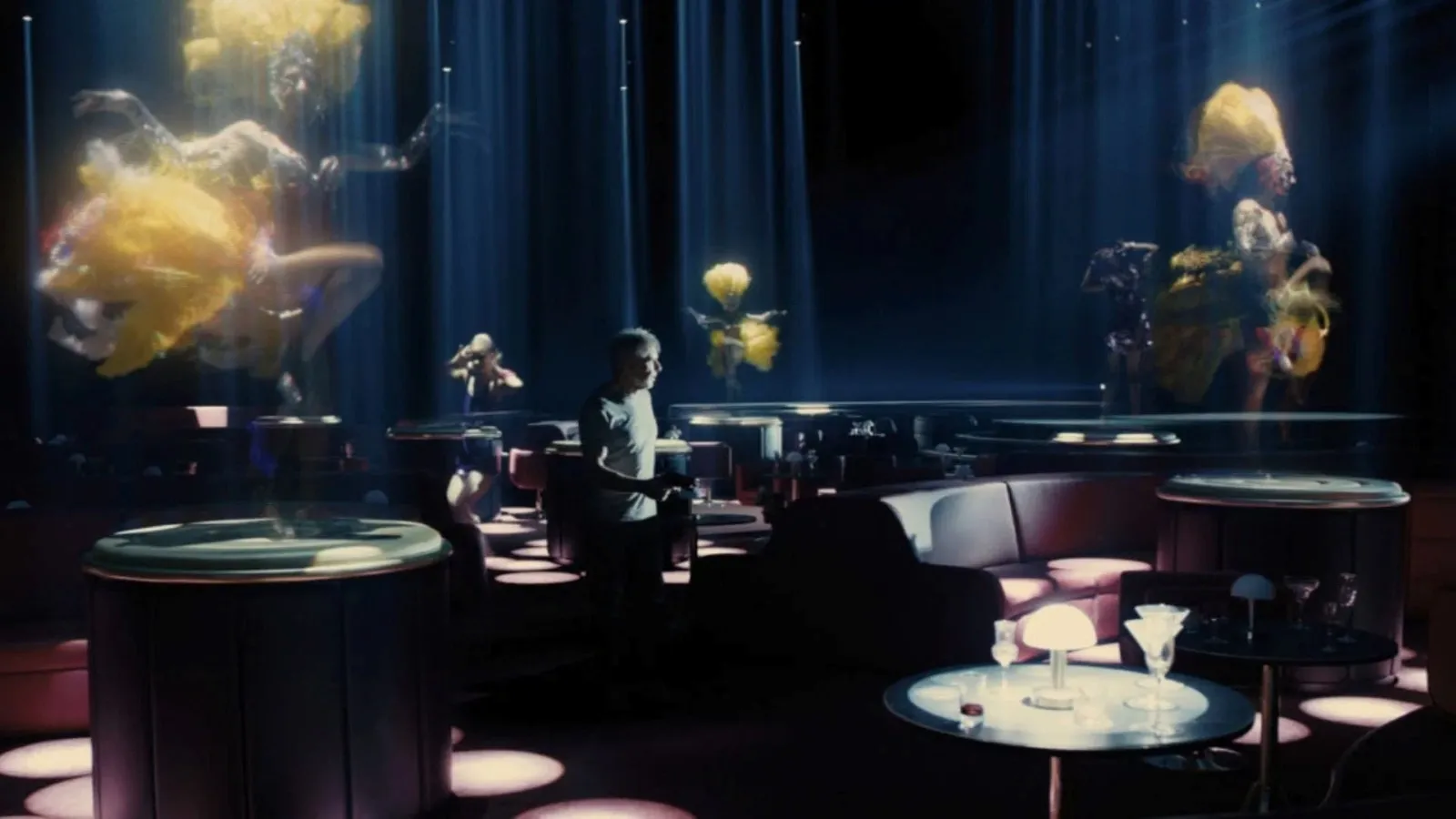
Harrison Ford as Deckard moving cautiously through one of the palace’s grand halls which was transformed into the film’s casino. Image credit: TMDB
Its Beaux-Arts grandeur gives the film a different flavour of futurism: civilisation after collapse. Vast staircases, heavy columns and ceremonial halls become ruins of excess, perfectly matching the orange radioactive fog of Villeneuve’s Las Vegas.
SciNexic note: Blade Runner 2049 is not space opera in the traditional starship sense, but its off-world colonisation backdrop and cosmic industrial scale make it essential near-space sci-fi architecture.
4. Marin County Civic Centre — Gattaca
Andrew Niccol’s Gattaca needed a future that felt immaculate, rational and quietly inhuman. It found one in the Marin County Civic Centre in San Rafael, California — the final major commission by Frank Lloyd Wright.
The building appears as the headquarters of the Gattaca Aerospace Corporation, where Vincent Freeman dreams of leaving Earth despite a society built around genetic selection. Its long horizontal lines, blue roof, circular openings and calm, institutional geometry create a future without clutter. It is not flashy; it is controlled.
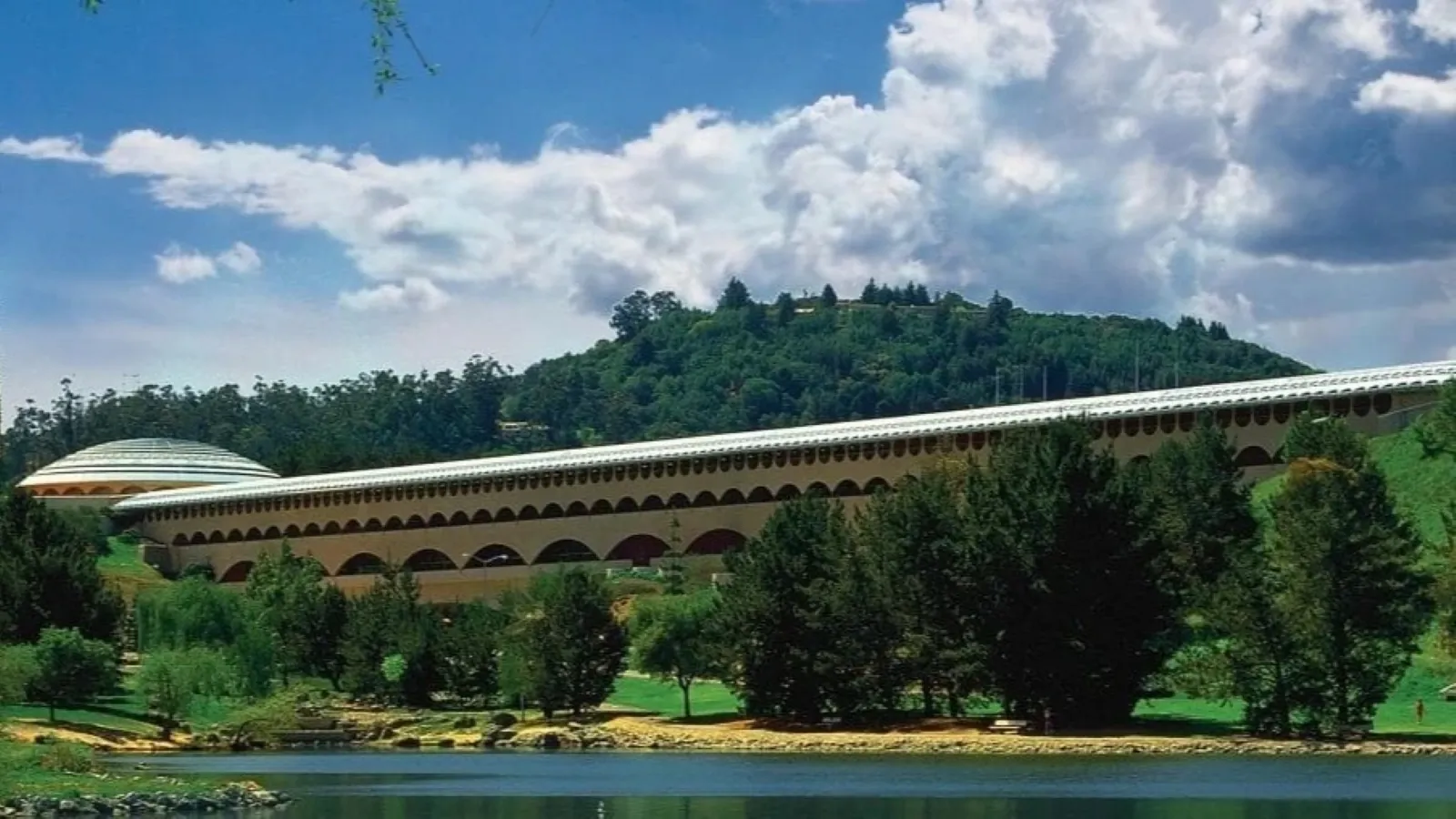
The Civic Centre’s elaborate form and detailing echo the sense of order that defines Gattaca’s pristine authoritarian world. Image credit: Frank Lloyd Wright Foundation
That restraint is exactly why it works. Gattaca is about human aspiration trapped inside beautiful systems of exclusion. Wright’s civic architecture gives the film a believable near-future public face: elegant, bureaucratic, and cold enough to make a rocket launch feel like an act of rebellion.
Trivia: the location has a screen afterlife beyond Gattaca, but here it feels almost custom-built for aerospace destiny — a launchpad disguised as a government building.
5. Salk Institute — The Island
Michael Bay’s The Island used the Salk Institute for Biological Studies in La Jolla, California, as part of its sterile future-world architecture. Designed by Louis Kahn with landscape input from Luis Barragán, the Salk Institute is one of modernism’s great temples: two mirrored concrete blocks framing a thin channel of water that points towards the Pacific.
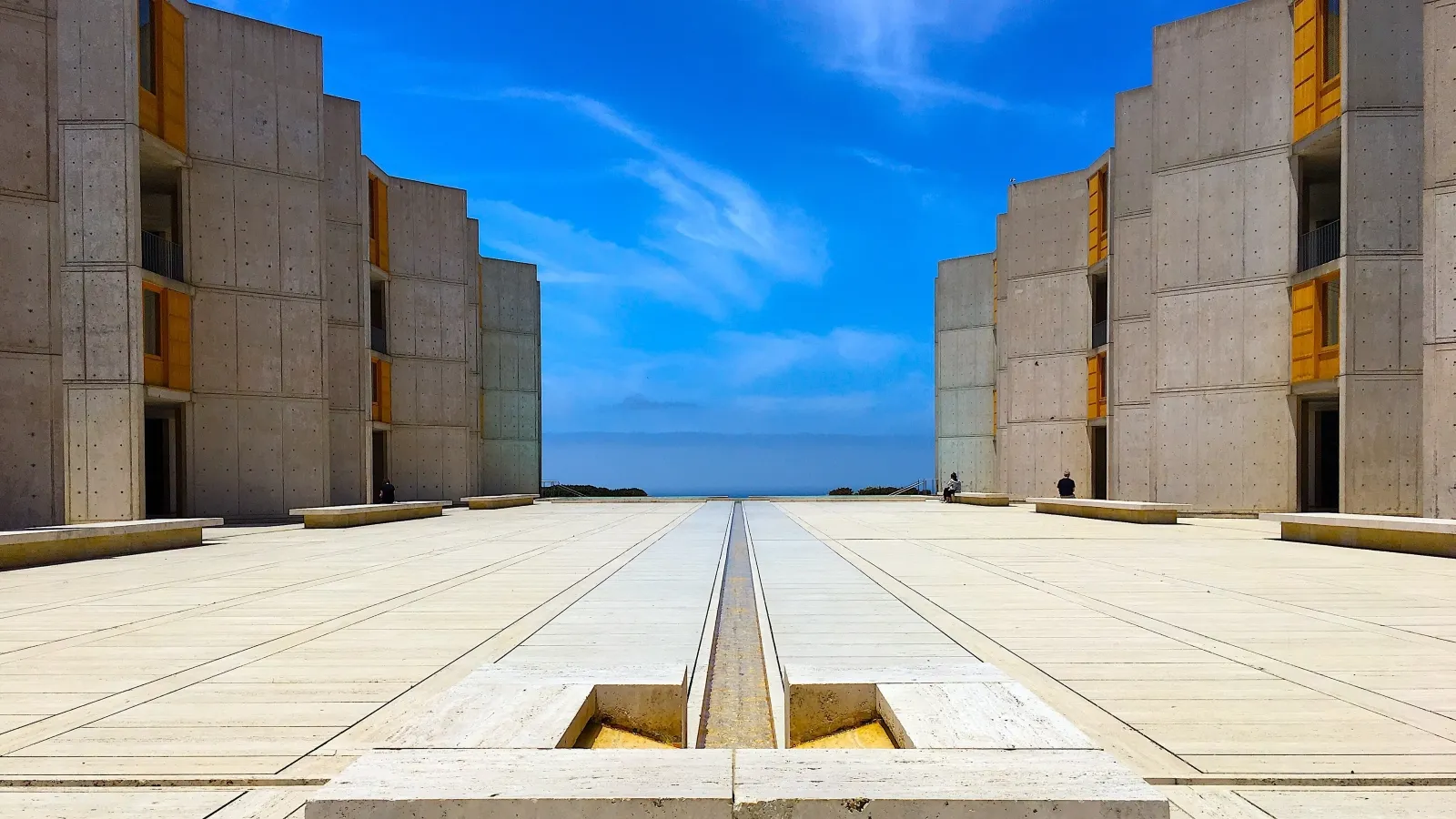
The Salk Institute’s austere, temple‑like grandeur and sharp monolithic lines make it an ideal backdrop for The Island’s sleek future world. Image credit: Codera23/Wikimedia
In sci-fi terms, it is irresistible. The plaza feels sacred and clinical at once, a place where science could either save humanity or erase it. That duality suits The Island, a film built around cloning, corporate secrecy and manufactured lives.
An interior sequence from The Island that takes full advantage of the Institute’s raw textures and vast volumes to express its controlled, high‑tech future. Image credit: TMDB
Its power lies in the negative space. Kahn’s concrete does not shout “future”; it whispers “system”. The ocean view becomes a vanishing point, turning the building into a corridor between human ambition and ethical abyss.
Honourable Mentions
L’Hemisfèric, Valencia — Tomorrowland
Part of Calatrava’s City of Arts and Sciences, it helped sell Disney’s gleaming alternate future. Its eye-like form practically arrives pre-rendered for sci-fi.
Adams Plaza Bridge, Canary Wharf — Andor
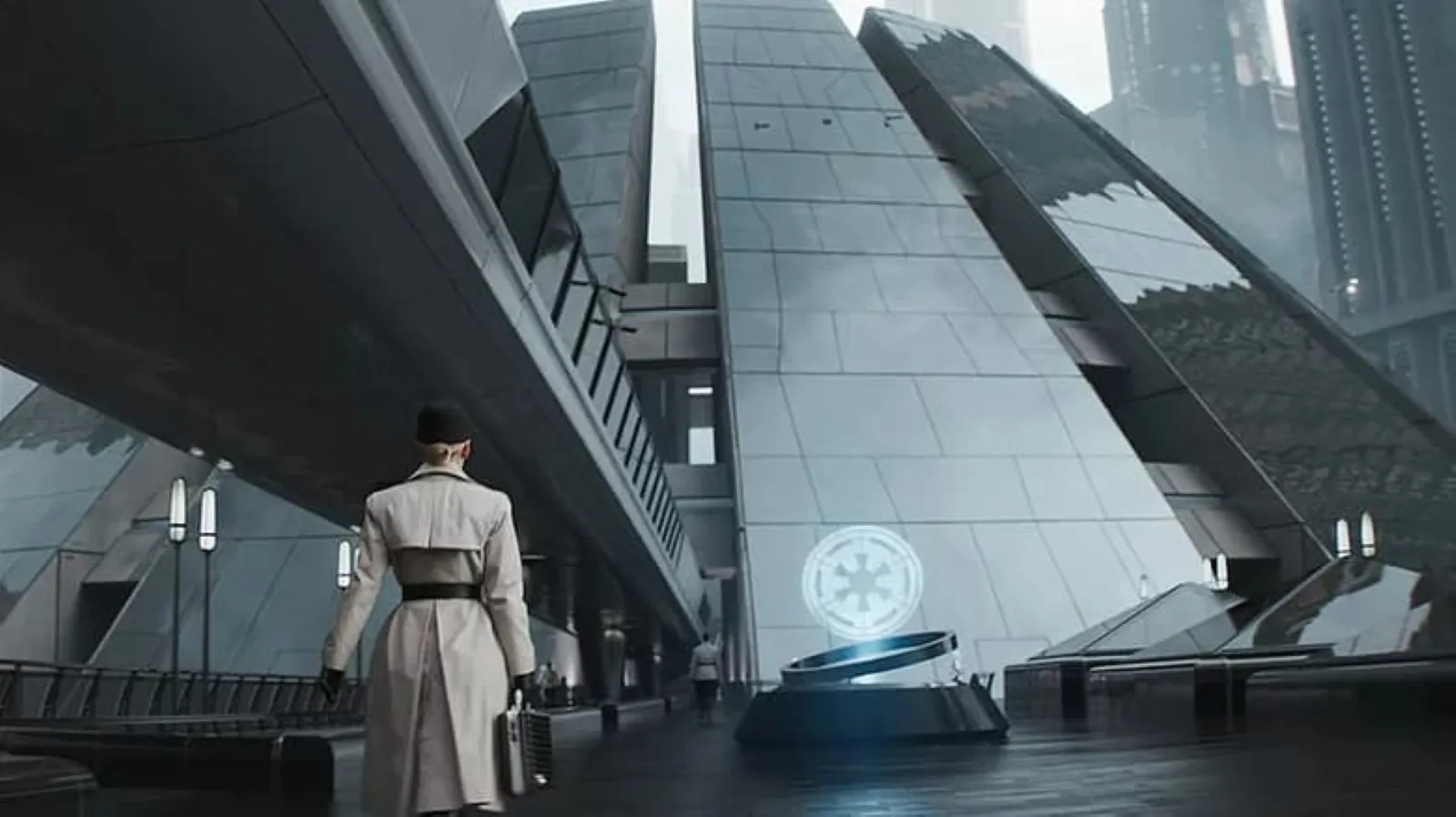
Coruscant’s stark ISB Headquarters were modelled on the bridge, its crisp futurist lines echoing the Empire’s ethos. Image credit: LucasFilm/StarWarsNewsnet.com
Canary Wharf also appears in Andor as part of the Imperial Security Bureau environment, proving London’s financial district remains one of Earth’s most useful gateways to Coruscant.
SciNexic Summary
The best space sci-fi locations do not merely look futuristic. They carry ideology in their walls. Calatrava gives Andor imperial elegance. Foster gives Rogue One mechanised order. Alpár gives Blade Runner 2049 faded power. Wright gives Gattaca controlled aspiration. Kahn gives The Island scientific unease.
The future, it turns out, has already been built. It is just waiting for the cameras.
For more deep dives into the science and spectacle of space sci-fi, keep exploring Scinexic.com—where the future is always just a click away.
Space sci-fi loves impossible architecture: Senate plazas, corporate temples, alien colonies and imperial bunkers built to make humanity feel tiny. Yet some of the genre’s most convincing futures were not born in a VFX suite. They were found in real buildings — museums, transport hubs, civic centres and abandoned palaces whose architecture already looked halfway to another century.
Here are five real-world buildings that helped well-known space sci-fi titles feel larger, stranger and more believable.
1. Ciudad de las Artes y las Ciencias — Andor and Coruscant’s upper levels
Valencia’s Ciudad de las Artes y las Ciencias was designed principally by Spanish architect Santiago Calatrava, with Félix Candela also associated with the Oceanogràfic. Its white ribs, skeletal vaults, reflecting pools and operatic scale have long made it a gift to science fiction.
Andor Season 2 filmed multiple Senate sequences across the complex’s underpasses and colonnaded walkways. Image credit: Carlos Cunha/Wikimedia
For Andor Season 2, the complex became part of Coruscant, the political heart of the Empire. Spanish outlet Las Provincias reported that Lucasfilm used the site for the series and quoted creator Tony Gilroy calling Valencia “incredibly valuable” and “absolutely amazing”. Executive producer Luke Hull described its architecture as something the team could integrate to represent “the upper part of Coruscant”.
Mon Mothma (Genevieve O'Reilly) and Luthen (Stellan Skarsgård) during a swift, discreet meeting in one of the complex's elaborate covered walkways. Image credit: TMDB
Why does it work? Because Calatrava’s architecture is both utopian and faintly authoritarian: clean, monumental, ceremonial. It looks like a future that has polished away its dirt — perfect for Andor’s portrait of imperial power hiding brutality beneath elegance.
Trivia: the same Valencia complex has also appeared in Tomorrowland, Doctor Who and Westworld, according to Spain Screen Tourism.
2. Canary Wharf Underground Station — Rogue One: A Star Wars Story
Few London commuters expect to pass through the Empire on the Jubilee line. But Canary Wharf Underground Station, designed by Foster + Partners under Norman Foster, became the interior of the Imperial Security Complex on Scarif in Rogue One.
The Worldwide Guide to Movie Locations notes that the Scarif security-complex scenes with Jyn Erso, Cassian Andor and K-2SO were filmed at Canary Wharf Tube Station, with shooting reportedly squeezed into the narrow overnight window when the Underground was closed. The station’s cavernous escalators, dark metal surfaces, glass canopies and disciplined symmetry needed surprisingly little persuasion to become Imperial infrastructure.
Scene image of Canary Warf Underground Station as Scarif, the Imperial base where the Death Star schematics were stored. Image credit: LucasFilm-Disney/Londonist.com
Director Gareth Edwards’ attachment to the place is wonderfully personal. According to MyLondon, he recalled thinking of Canary Wharf:
“This is something from the future. This is like a sci-fi movie. If I ever get to do a sci-fi film in my life, I’m going to film it here.”
He did. The result is one of modern Star Wars’ most satisfying location steals: public transport transformed into military bureaucracy.
3. Budapest Stock Exchange Palace — Blade Runner 2049
Not all futuristic architecture is shiny. Sometimes the future is old, hollowed out and haunted.
In Denis Villeneuve’s Blade Runner 2049, the former Budapest Stock Exchange Palace became the decaying Las Vegas casino where Officer K finally finds Rick Deckard. The building, also known as the Exchange Palace, was originally built in 1905 and designed by Hungarian architect Ignác Alpár.
The Palace’s classical ornamentation and lavish interior fits seamlessly into Blade Runner 2049’s moody, dystopian future. Image credit: Pataki Tamás/WeloveBudapest.com
Location database Sceen It identifies it as the Blade Runner 2049 location for K’s search for Deckard, while We Love Budapest also adds that the historic Stock Exchange Building at Szabadság Square was used for the “Vintage Casino”.
Harrison Ford as Deckard moving cautiously through one of the palace’s grand halls which was transformed into the film’s casino. Image credit: TMDB
Its Beaux-Arts grandeur gives the film a different flavour of futurism: civilisation after collapse. Vast staircases, heavy columns and ceremonial halls become ruins of excess, perfectly matching the orange radioactive fog of Villeneuve’s Las Vegas.
SciNexic note: Blade Runner 2049 is not space opera in the traditional starship sense, but its off-world colonisation backdrop and cosmic industrial scale make it essential near-space sci-fi architecture.
4. Marin County Civic Centre — Gattaca
Andrew Niccol’s Gattaca needed a future that felt immaculate, rational and quietly inhuman. It found one in the Marin County Civic Centre in San Rafael, California — the final major commission by Frank Lloyd Wright.
The building appears as the headquarters of the Gattaca Aerospace Corporation, where Vincent Freeman dreams of leaving Earth despite a society built around genetic selection. Its long horizontal lines, blue roof, circular openings and calm, institutional geometry create a future without clutter. It is not flashy; it is controlled.
The Civic Centre’s elaborate form and detailing echo the sense of order that defines Gattaca’s pristine authoritarian world. Image credit: Frank Lloyd Wright Foundation
That restraint is exactly why it works. Gattaca is about human aspiration trapped inside beautiful systems of exclusion. Wright’s civic architecture gives the film a believable near-future public face: elegant, bureaucratic, and cold enough to make a rocket launch feel like an act of rebellion.
Trivia: the location has a screen afterlife beyond Gattaca, but here it feels almost custom-built for aerospace destiny — a launchpad disguised as a government building.
5. Salk Institute — The Island
Michael Bay’s The Island used the Salk Institute for Biological Studies in La Jolla, California, as part of its sterile future-world architecture. Designed by Louis Kahn with landscape input from Luis Barragán, the Salk Institute is one of modernism’s great temples: two mirrored concrete blocks framing a thin channel of water that points towards the Pacific.
The Salk Institute’s austere, temple‑like grandeur and sharp monolithic lines make it an ideal backdrop for The Island’s sleek future world. Image credit: Codera23/Wikimedia
In sci-fi terms, it is irresistible. The plaza feels sacred and clinical at once, a place where science could either save humanity or erase it. That duality suits The Island, a film built around cloning, corporate secrecy and manufactured lives.
An interior sequence from The Island that takes full advantage of the Institute’s raw textures and vast volumes to express its controlled, high‑tech future. Image credit: TMDB
Its power lies in the negative space. Kahn’s concrete does not shout “future”; it whispers “system”. The ocean view becomes a vanishing point, turning the building into a corridor between human ambition and ethical abyss.
Honourable Mentions
L’Hemisfèric, Valencia — Tomorrowland
Part of Calatrava’s City of Arts and Sciences, it helped sell Disney’s gleaming alternate future. Its eye-like form practically arrives pre-rendered for sci-fi.
Adams Plaza Bridge, Canary Wharf — Andor
Coruscant’s stark ISB Headquarters were modelled on the bridge, its crisp futurist lines echoing the Empire’s ethos. Image credit: LucasFilm/StarWarsNewsnet.com
Canary Wharf also appears in Andor as part of the Imperial Security Bureau environment, proving London’s financial district remains one of Earth’s most useful gateways to Coruscant.
SciNexic Summary
The best space sci-fi locations do not merely look futuristic. They carry ideology in their walls. Calatrava gives Andor imperial elegance. Foster gives Rogue One mechanised order. Alpár gives Blade Runner 2049 faded power. Wright gives Gattaca controlled aspiration. Kahn gives The Island scientific unease.
The future, it turns out, has already been built. It is just waiting for the cameras.
For more deep dives into the science and spectacle of space sci-fi, keep exploring Scinexic.com—where the future is always just a click away.
Space sci-fi loves impossible architecture: Senate plazas, corporate temples, alien colonies and imperial bunkers built to make humanity feel tiny. Yet some of the genre’s most convincing futures were not born in a VFX suite. They were found in real buildings — museums, transport hubs, civic centres and abandoned palaces whose architecture already looked halfway to another century.
Here are five real-world buildings that helped well-known space sci-fi titles feel larger, stranger and more believable.
1. Ciudad de las Artes y las Ciencias — Andor and Coruscant’s upper levels
Valencia’s Ciudad de las Artes y las Ciencias was designed principally by Spanish architect Santiago Calatrava, with Félix Candela also associated with the Oceanogràfic. Its white ribs, skeletal vaults, reflecting pools and operatic scale have long made it a gift to science fiction.
Andor Season 2 filmed multiple Senate sequences across the complex’s underpasses and colonnaded walkways. Image credit: Carlos Cunha/Wikimedia
For Andor Season 2, the complex became part of Coruscant, the political heart of the Empire. Spanish outlet Las Provincias reported that Lucasfilm used the site for the series and quoted creator Tony Gilroy calling Valencia “incredibly valuable” and “absolutely amazing”. Executive producer Luke Hull described its architecture as something the team could integrate to represent “the upper part of Coruscant”.
Mon Mothma (Genevieve O'Reilly) and Luthen (Stellan Skarsgård) during a swift, discreet meeting in one of the complex's elaborate covered walkways. Image credit: TMDB
Why does it work? Because Calatrava’s architecture is both utopian and faintly authoritarian: clean, monumental, ceremonial. It looks like a future that has polished away its dirt — perfect for Andor’s portrait of imperial power hiding brutality beneath elegance.
Trivia: the same Valencia complex has also appeared in Tomorrowland, Doctor Who and Westworld, according to Spain Screen Tourism.
2. Canary Wharf Underground Station — Rogue One: A Star Wars Story
Few London commuters expect to pass through the Empire on the Jubilee line. But Canary Wharf Underground Station, designed by Foster + Partners under Norman Foster, became the interior of the Imperial Security Complex on Scarif in Rogue One.
The Worldwide Guide to Movie Locations notes that the Scarif security-complex scenes with Jyn Erso, Cassian Andor and K-2SO were filmed at Canary Wharf Tube Station, with shooting reportedly squeezed into the narrow overnight window when the Underground was closed. The station’s cavernous escalators, dark metal surfaces, glass canopies and disciplined symmetry needed surprisingly little persuasion to become Imperial infrastructure.
Scene image of Canary Warf Underground Station as Scarif, the Imperial base where the Death Star schematics were stored. Image credit: LucasFilm-Disney/Londonist.com
Director Gareth Edwards’ attachment to the place is wonderfully personal. According to MyLondon, he recalled thinking of Canary Wharf:
“This is something from the future. This is like a sci-fi movie. If I ever get to do a sci-fi film in my life, I’m going to film it here.”
He did. The result is one of modern Star Wars’ most satisfying location steals: public transport transformed into military bureaucracy.
3. Budapest Stock Exchange Palace — Blade Runner 2049
Not all futuristic architecture is shiny. Sometimes the future is old, hollowed out and haunted.
In Denis Villeneuve’s Blade Runner 2049, the former Budapest Stock Exchange Palace became the decaying Las Vegas casino where Officer K finally finds Rick Deckard. The building, also known as the Exchange Palace, was originally built in 1905 and designed by Hungarian architect Ignác Alpár.
The Palace’s classical ornamentation and lavish interior fits seamlessly into Blade Runner 2049’s moody, dystopian future. Image credit: Pataki Tamás/WeloveBudapest.com
Location database Sceen It identifies it as the Blade Runner 2049 location for K’s search for Deckard, while We Love Budapest also adds that the historic Stock Exchange Building at Szabadság Square was used for the “Vintage Casino”.
Harrison Ford as Deckard moving cautiously through one of the palace’s grand halls which was transformed into the film’s casino. Image credit: TMDB
Its Beaux-Arts grandeur gives the film a different flavour of futurism: civilisation after collapse. Vast staircases, heavy columns and ceremonial halls become ruins of excess, perfectly matching the orange radioactive fog of Villeneuve’s Las Vegas.
SciNexic note: Blade Runner 2049 is not space opera in the traditional starship sense, but its off-world colonisation backdrop and cosmic industrial scale make it essential near-space sci-fi architecture.
4. Marin County Civic Centre — Gattaca
Andrew Niccol’s Gattaca needed a future that felt immaculate, rational and quietly inhuman. It found one in the Marin County Civic Centre in San Rafael, California — the final major commission by Frank Lloyd Wright.
The building appears as the headquarters of the Gattaca Aerospace Corporation, where Vincent Freeman dreams of leaving Earth despite a society built around genetic selection. Its long horizontal lines, blue roof, circular openings and calm, institutional geometry create a future without clutter. It is not flashy; it is controlled.
The Civic Centre’s elaborate form and detailing echo the sense of order that defines Gattaca’s pristine authoritarian world. Image credit: Frank Lloyd Wright Foundation
That restraint is exactly why it works. Gattaca is about human aspiration trapped inside beautiful systems of exclusion. Wright’s civic architecture gives the film a believable near-future public face: elegant, bureaucratic, and cold enough to make a rocket launch feel like an act of rebellion.
Trivia: the location has a screen afterlife beyond Gattaca, but here it feels almost custom-built for aerospace destiny — a launchpad disguised as a government building.
5. Salk Institute — The Island
Michael Bay’s The Island used the Salk Institute for Biological Studies in La Jolla, California, as part of its sterile future-world architecture. Designed by Louis Kahn with landscape input from Luis Barragán, the Salk Institute is one of modernism’s great temples: two mirrored concrete blocks framing a thin channel of water that points towards the Pacific.
The Salk Institute’s austere, temple‑like grandeur and sharp monolithic lines make it an ideal backdrop for The Island’s sleek future world. Image credit: Codera23/Wikimedia
In sci-fi terms, it is irresistible. The plaza feels sacred and clinical at once, a place where science could either save humanity or erase it. That duality suits The Island, a film built around cloning, corporate secrecy and manufactured lives.
An interior sequence from The Island that takes full advantage of the Institute’s raw textures and vast volumes to express its controlled, high‑tech future. Image credit: TMDB
Its power lies in the negative space. Kahn’s concrete does not shout “future”; it whispers “system”. The ocean view becomes a vanishing point, turning the building into a corridor between human ambition and ethical abyss.
Honourable Mentions
L’Hemisfèric, Valencia — Tomorrowland
Part of Calatrava’s City of Arts and Sciences, it helped sell Disney’s gleaming alternate future. Its eye-like form practically arrives pre-rendered for sci-fi.
Adams Plaza Bridge, Canary Wharf — Andor
Coruscant’s stark ISB Headquarters were modelled on the bridge, its crisp futurist lines echoing the Empire’s ethos. Image credit: LucasFilm/StarWarsNewsnet.com
Canary Wharf also appears in Andor as part of the Imperial Security Bureau environment, proving London’s financial district remains one of Earth’s most useful gateways to Coruscant.
SciNexic Summary
The best space sci-fi locations do not merely look futuristic. They carry ideology in their walls. Calatrava gives Andor imperial elegance. Foster gives Rogue One mechanised order. Alpár gives Blade Runner 2049 faded power. Wright gives Gattaca controlled aspiration. Kahn gives The Island scientific unease.
The future, it turns out, has already been built. It is just waiting for the cameras.
For more deep dives into the science and spectacle of space sci-fi, keep exploring Scinexic.com—where the future is always just a click away.
Image Gallery
Comments
Please be kind and considerate. Any abusive or offensive comments will be sent out the airlock! Thank You.
Please be kind and considerate. Any abusive or offensive comments will be sent out the airlock! Thank You.
Join the SciNexic Crew
Related Posts

Share on Instagram
Share on Instagram
Banner Image - Rogue One: A Star Wars Story scene image - BBC.co.uk - Copyright: LucasFilm/Disney
Main Article - All images and media are the property of their respective owners.