


The SciNexic Files
The SciNexic Files
The SciNexic Files
Space News
The Phoenix Planet: How a Dead Star Gave Birth to a New World — and Why It Rewrites Space Sci-Fi's Oldest Assumption
The Phoenix Planet: How a Dead Star Gave Birth to a New World — and Why It Rewrites Space Sci-Fi's Oldest Assumption
In 1999, the Hubble Space Telescope stared at a white dwarf 270 light-years away and saw something it could not explain. The star, catalogued as HS 0209+0832, was polluting its own atmosphere with chemicals that had no business being there — niobium, zinc, copper — elements forged not in stellar birth but in stellar death. For twenty-seven years, the data sat in archives like an unsolved crime. Then, this week, a team led by the University of Warwick published their findings in Nature Astronomy and changed how we understand planetary survival. The white dwarf is not merely contaminated. It is parenting. A second-generation planet, roughly Jupiter-sized, is orbiting the corpse of its predecessor at a distance of just 3.7 million miles, completing a revolution every 4.4 days. It did not form when the star formed. It formed from the star's ashes. And if planets can be born from death, then every space sci-fi story about apocalypse and renewal just gained a new scientific foundation.
Hubble's Cold Case: The 1999 Observation That Waited Three Decades for an Answer
White dwarfs are stellar corpses — the collapsed cores of stars that have exhausted their nuclear fuel and shed their outer layers. In the standard model, any planets orbiting such a star should have been swallowed, shattered, or incinerated during the red giant phase that precedes white dwarf formation. What survives, according to conventional wisdom, is debris: dust, asteroids, maybe the occasional disintegrating rocky body raining material onto the stellar surface. What does not survive is an intact, gas-giant planet with a stable orbit and an atmosphere of its own.
The 1999 Hubble observations of HS 0209+0832 detected atmospheric pollution — heavy metals that should have sunk beneath the photosphere long ago unless fresh material was continually arriving. The unusual element was niobium, a metal rarely found in first-generation planetary systems and strongly associated with the nucleosynthesis that occurs during a star's asymptotic giant branch phase. The researchers, reanalysing those archival observations alongside data from the retired Far Ultraviolet Spectroscopic Explorer (FUSE), concluded that the material was not random debris. It was atmospheric evaporation from a planet undergoing photoevaporation in real time.
TESS observations confirmed a periodic brightness dip of 4.4 days — the orbital signature of a body transiting, or nearly transiting, the white dwarf's disc. The planet is losing mass to stellar irradiation, creating a gaseous disc that spirals inward and "pollutes" the white dwarf's atmosphere with the very elements that betray its presence. This is not a planet that survived its star's death. This is a planet that was born from it.
From Ashes to Atmosphere: The Physics of Second-Generation World-Building
The mechanism is as extraordinary as the discovery. When HS 0209+0832 entered its asymptotic giant branch phase, it expelled vast quantities of gas and dust into a circumstellar disc. That disc, rich in heavy elements synthesised during the star's death throes, did not merely disperse. It cooled, clumped, and coalesced into a new planetary body — a second-generation world with a chemical composition fundamentally different from anything that formed alongside its host star.
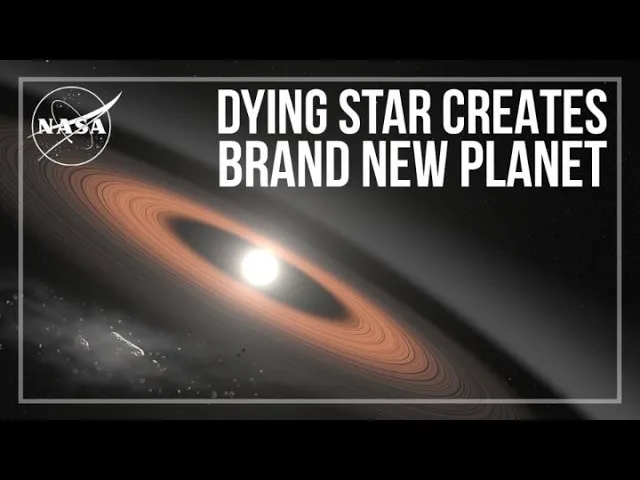
Dying Star Creates Brand New Planet. By NASA. From @NASAGoddard
The planet now orbits at approximately 0.04 astronomical units, well inside the orbit of Mercury in our own solar system. At that distance, the white dwarf's residual heat is stripping the planet's atmosphere at a measurable rate, creating a continuous inflow of material onto the stellar surface. The researchers estimate that the planet could persist in this configuration for millions of years — long enough, perhaps, to be observed by future generations of telescopes, and certainly long enough to challenge every assumption about the lifespan of planetary systems.
Phys.org's analysis frames the discovery as a direct glimpse into our own solar system's distant future. In approximately five billion years, the Sun will exhaust its hydrogen fuel, expand into a red giant that consumes Mercury and Venus, and collapse into a white dwarf not unlike HS 0209+0832. Earth will not survive that transition in any recognisable form. But the material that once constituted our planet — and Mars, and the asteroid belt, and the outer gas giants — will form a new disc around the remnant star. Whether that disc can produce new worlds has been, until this week, a matter of theoretical speculation. It is now an empirical fact.
The Science Fiction Precedent: Why This Discovery Feeds the Genre's Deepest Myth
Space sci-fi has always operated in the tension between extinction and renewal. From the terraforming of Mars in Kim Stanley Robinson's Red Mars trilogy to the genesis of new Earths in Interstellar, the genre's most enduring narratives depend on the possibility that death is not final — that destruction contains within it the seeds of new creation. What HS 0209+0832 provides is not merely a scientific analogue to that myth. It is proof that the analogue was closer to reality than we knew.
The discovery also reframes a persistent subgenre: post-solar fiction. Works such as Alastair Reynolds's House of Suns and Stephen Baxter's Flux have imagined civilisations persisting around white dwarf stars, drawing energy from diminished but stable stellar remnants. Those scenarios were typically defended on the grounds that white dwarfs emit consistent radiation for billions of years — longer than the current age of the universe. What they lacked was a mechanism for planetary formation in the post-stellar environment. A second-generation planet solves that problem. If new worlds can form around dead stars, then new biospheres can, in principle, follow. The timescales are geological; the chemistry is exotic; the possibility is real.
What This Means for Exoplanet Research: The Habitable Zone Just Got Stranger
The concept of a habitable zone — the orbital region around a star where liquid water can exist on a planetary surface — has been refined repeatedly since its first formal definition in the 1990s. Around white dwarfs, the habitable zone is narrow, close to the star, and transient, shifting inward as the stellar remnant cools. HS 0209+0832's planet is currently inside that zone, or near its inner edge, depending on atmospheric composition assumptions. The fact that it is actively losing atmosphere complicates any biological prospecting, but it does not eliminate it.

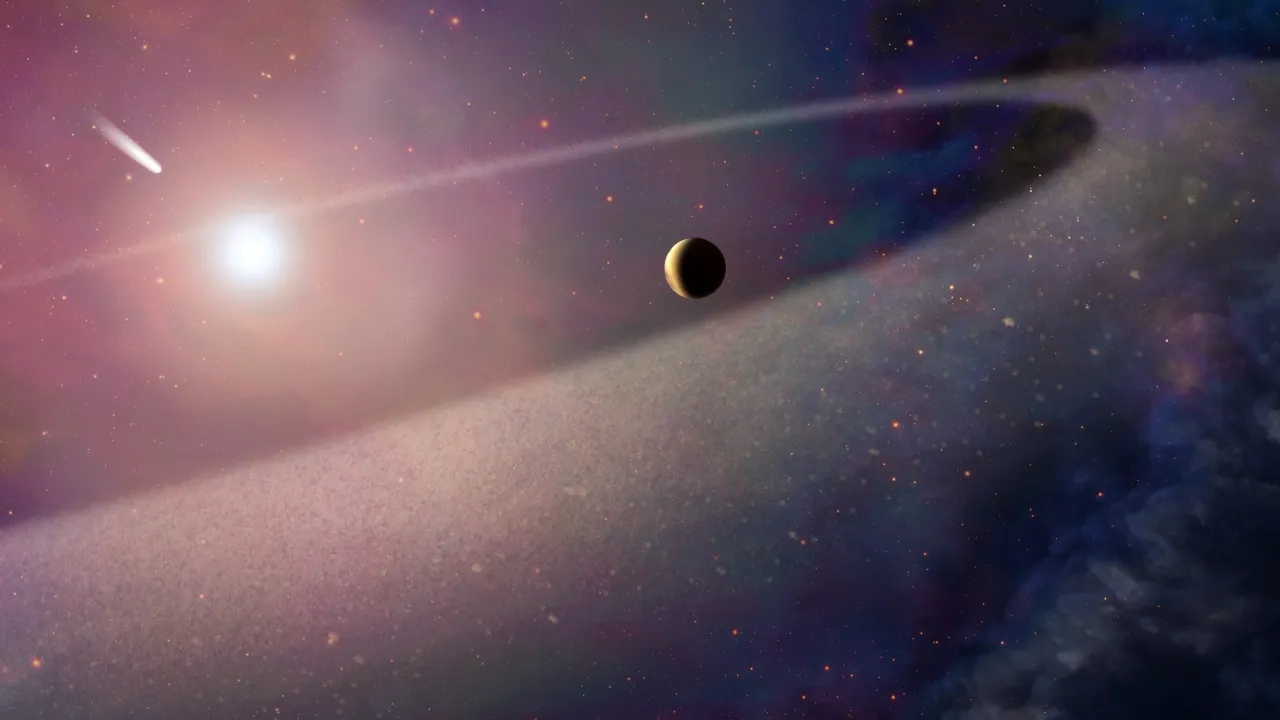
According to the numbers, HS 0209+0832 may host one of astronomy's most unusual worlds. Credit: NASA
More significantly, the discovery expands the catalogue of environments where planetary formation is possible. If second-generation planets are common around white dwarfs — and the chemical pollution detected in hundreds of other white dwarf atmospheres suggests they may be — then the number of potentially observable planetary systems in the galaxy increases by a factor that has yet to be calculated. The James Webb Space Telescope, with its sensitivity to infrared signatures from cool stellar remnants, is the ideal instrument to follow up. Expect a dedicated observing campaign within the year.
The Phoenix Principle: How Space Sci-Fi's Most Ancient Trope Became Scientific Fact
There is a reason the phoenix appears in so many space operas. The image of rebirth from destruction speaks to something fundamental in how humans imagine cosmic time: not as linear decay but as cyclical transformation. HS 0209+0832 does not merely confirm that trope. It grounds it in the specific chemistry of niobium, the orbital mechanics of a 4.4-day period, and the spectroscopic signatures of atmospheric escape.
For SciNexic, the lesson is methodological as much as scientific. The discovery emerged not from a new telescope but from a new analysis of old data — a reminder that the universe's most significant revelations are sometimes waiting in archives we have already built. The Warwick team's decision to revisit Hubble's 1999 observations with updated chemical databases and cross-referenced TESS photometry is a model of how contemporary astronomy operates: not through single dramatic observations but through patient, synthetic re-examination. Space sci-fi, which often privileges the lone visionary and the sudden breakthrough, might usefully learn from that patience.
The white dwarf HS 0209+0832 will continue to cool, its planet will continue to evaporate, and the disc of material around them both will eventually disperse or coalesce into something we cannot yet predict. But the principle has been established. Stars die. Planets are born from their remains. And the story of the cosmos is not a tragedy of endings but a narrative of reinvention — one that space sci-fi has been telling, with more intuition than evidence, for generations. The evidence, at last, has arrived.
For more deep dives into the science and spectacle of space sci-fi, keep exploring Scinexic.com—where the future is always just a page away.
Further Reading:
NASA: Suspected Second-Generation Planet Solves Hubble Cold Case
Nature Astronomy: Original Research Publication
Phys.org: Phoenix Planet — Astronomers Discover World Reborn from Dead Star
Nature Astronomy: Original Research Publication
SciNexic.com may earn a commission through affiliate links, ensuring continued cosmic content.
In 1999, the Hubble Space Telescope stared at a white dwarf 270 light-years away and saw something it could not explain. The star, catalogued as HS 0209+0832, was polluting its own atmosphere with chemicals that had no business being there — niobium, zinc, copper — elements forged not in stellar birth but in stellar death. For twenty-seven years, the data sat in archives like an unsolved crime. Then, this week, a team led by the University of Warwick published their findings in Nature Astronomy and changed how we understand planetary survival. The white dwarf is not merely contaminated. It is parenting. A second-generation planet, roughly Jupiter-sized, is orbiting the corpse of its predecessor at a distance of just 3.7 million miles, completing a revolution every 4.4 days. It did not form when the star formed. It formed from the star's ashes. And if planets can be born from death, then every space sci-fi story about apocalypse and renewal just gained a new scientific foundation.
Hubble's Cold Case: The 1999 Observation That Waited Three Decades for an Answer
White dwarfs are stellar corpses — the collapsed cores of stars that have exhausted their nuclear fuel and shed their outer layers. In the standard model, any planets orbiting such a star should have been swallowed, shattered, or incinerated during the red giant phase that precedes white dwarf formation. What survives, according to conventional wisdom, is debris: dust, asteroids, maybe the occasional disintegrating rocky body raining material onto the stellar surface. What does not survive is an intact, gas-giant planet with a stable orbit and an atmosphere of its own.
The 1999 Hubble observations of HS 0209+0832 detected atmospheric pollution — heavy metals that should have sunk beneath the photosphere long ago unless fresh material was continually arriving. The unusual element was niobium, a metal rarely found in first-generation planetary systems and strongly associated with the nucleosynthesis that occurs during a star's asymptotic giant branch phase. The researchers, reanalysing those archival observations alongside data from the retired Far Ultraviolet Spectroscopic Explorer (FUSE), concluded that the material was not random debris. It was atmospheric evaporation from a planet undergoing photoevaporation in real time.
TESS observations confirmed a periodic brightness dip of 4.4 days — the orbital signature of a body transiting, or nearly transiting, the white dwarf's disc. The planet is losing mass to stellar irradiation, creating a gaseous disc that spirals inward and "pollutes" the white dwarf's atmosphere with the very elements that betray its presence. This is not a planet that survived its star's death. This is a planet that was born from it.
From Ashes to Atmosphere: The Physics of Second-Generation World-Building
The mechanism is as extraordinary as the discovery. When HS 0209+0832 entered its asymptotic giant branch phase, it expelled vast quantities of gas and dust into a circumstellar disc. That disc, rich in heavy elements synthesised during the star's death throes, did not merely disperse. It cooled, clumped, and coalesced into a new planetary body — a second-generation world with a chemical composition fundamentally different from anything that formed alongside its host star.
Dying Star Creates Brand New Planet. By NASA. From @NASAGoddard
The planet now orbits at approximately 0.04 astronomical units, well inside the orbit of Mercury in our own solar system. At that distance, the white dwarf's residual heat is stripping the planet's atmosphere at a measurable rate, creating a continuous inflow of material onto the stellar surface. The researchers estimate that the planet could persist in this configuration for millions of years — long enough, perhaps, to be observed by future generations of telescopes, and certainly long enough to challenge every assumption about the lifespan of planetary systems.
Phys.org's analysis frames the discovery as a direct glimpse into our own solar system's distant future. In approximately five billion years, the Sun will exhaust its hydrogen fuel, expand into a red giant that consumes Mercury and Venus, and collapse into a white dwarf not unlike HS 0209+0832. Earth will not survive that transition in any recognisable form. But the material that once constituted our planet — and Mars, and the asteroid belt, and the outer gas giants — will form a new disc around the remnant star. Whether that disc can produce new worlds has been, until this week, a matter of theoretical speculation. It is now an empirical fact.
The Science Fiction Precedent: Why This Discovery Feeds the Genre's Deepest Myth
Space sci-fi has always operated in the tension between extinction and renewal. From the terraforming of Mars in Kim Stanley Robinson's Red Mars trilogy to the genesis of new Earths in Interstellar, the genre's most enduring narratives depend on the possibility that death is not final — that destruction contains within it the seeds of new creation. What HS 0209+0832 provides is not merely a scientific analogue to that myth. It is proof that the analogue was closer to reality than we knew.
The discovery also reframes a persistent subgenre: post-solar fiction. Works such as Alastair Reynolds's House of Suns and Stephen Baxter's Flux have imagined civilisations persisting around white dwarf stars, drawing energy from diminished but stable stellar remnants. Those scenarios were typically defended on the grounds that white dwarfs emit consistent radiation for billions of years — longer than the current age of the universe. What they lacked was a mechanism for planetary formation in the post-stellar environment. A second-generation planet solves that problem. If new worlds can form around dead stars, then new biospheres can, in principle, follow. The timescales are geological; the chemistry is exotic; the possibility is real.
What This Means for Exoplanet Research: The Habitable Zone Just Got Stranger
The concept of a habitable zone — the orbital region around a star where liquid water can exist on a planetary surface — has been refined repeatedly since its first formal definition in the 1990s. Around white dwarfs, the habitable zone is narrow, close to the star, and transient, shifting inward as the stellar remnant cools. HS 0209+0832's planet is currently inside that zone, or near its inner edge, depending on atmospheric composition assumptions. The fact that it is actively losing atmosphere complicates any biological prospecting, but it does not eliminate it.
According to the numbers, HS 0209+0832 may host one of astronomy's most unusual worlds. Credit: NASA
More significantly, the discovery expands the catalogue of environments where planetary formation is possible. If second-generation planets are common around white dwarfs — and the chemical pollution detected in hundreds of other white dwarf atmospheres suggests they may be — then the number of potentially observable planetary systems in the galaxy increases by a factor that has yet to be calculated. The James Webb Space Telescope, with its sensitivity to infrared signatures from cool stellar remnants, is the ideal instrument to follow up. Expect a dedicated observing campaign within the year.
The Phoenix Principle: How Space Sci-Fi's Most Ancient Trope Became Scientific Fact
There is a reason the phoenix appears in so many space operas. The image of rebirth from destruction speaks to something fundamental in how humans imagine cosmic time: not as linear decay but as cyclical transformation. HS 0209+0832 does not merely confirm that trope. It grounds it in the specific chemistry of niobium, the orbital mechanics of a 4.4-day period, and the spectroscopic signatures of atmospheric escape.
For SciNexic, the lesson is methodological as much as scientific. The discovery emerged not from a new telescope but from a new analysis of old data — a reminder that the universe's most significant revelations are sometimes waiting in archives we have already built. The Warwick team's decision to revisit Hubble's 1999 observations with updated chemical databases and cross-referenced TESS photometry is a model of how contemporary astronomy operates: not through single dramatic observations but through patient, synthetic re-examination. Space sci-fi, which often privileges the lone visionary and the sudden breakthrough, might usefully learn from that patience.
The white dwarf HS 0209+0832 will continue to cool, its planet will continue to evaporate, and the disc of material around them both will eventually disperse or coalesce into something we cannot yet predict. But the principle has been established. Stars die. Planets are born from their remains. And the story of the cosmos is not a tragedy of endings but a narrative of reinvention — one that space sci-fi has been telling, with more intuition than evidence, for generations. The evidence, at last, has arrived.
For more deep dives into the science and spectacle of space sci-fi, keep exploring Scinexic.com—where the future is always just a page away.
Further Reading:
NASA: Suspected Second-Generation Planet Solves Hubble Cold Case
Nature Astronomy: Original Research Publication
Phys.org: Phoenix Planet — Astronomers Discover World Reborn from Dead Star
Nature Astronomy: Original Research Publication
SciNexic.com may earn a commission through affiliate links, ensuring continued cosmic content.
In 1999, the Hubble Space Telescope stared at a white dwarf 270 light-years away and saw something it could not explain. The star, catalogued as HS 0209+0832, was polluting its own atmosphere with chemicals that had no business being there — niobium, zinc, copper — elements forged not in stellar birth but in stellar death. For twenty-seven years, the data sat in archives like an unsolved crime. Then, this week, a team led by the University of Warwick published their findings in Nature Astronomy and changed how we understand planetary survival. The white dwarf is not merely contaminated. It is parenting. A second-generation planet, roughly Jupiter-sized, is orbiting the corpse of its predecessor at a distance of just 3.7 million miles, completing a revolution every 4.4 days. It did not form when the star formed. It formed from the star's ashes. And if planets can be born from death, then every space sci-fi story about apocalypse and renewal just gained a new scientific foundation.
Hubble's Cold Case: The 1999 Observation That Waited Three Decades for an Answer
White dwarfs are stellar corpses — the collapsed cores of stars that have exhausted their nuclear fuel and shed their outer layers. In the standard model, any planets orbiting such a star should have been swallowed, shattered, or incinerated during the red giant phase that precedes white dwarf formation. What survives, according to conventional wisdom, is debris: dust, asteroids, maybe the occasional disintegrating rocky body raining material onto the stellar surface. What does not survive is an intact, gas-giant planet with a stable orbit and an atmosphere of its own.
The 1999 Hubble observations of HS 0209+0832 detected atmospheric pollution — heavy metals that should have sunk beneath the photosphere long ago unless fresh material was continually arriving. The unusual element was niobium, a metal rarely found in first-generation planetary systems and strongly associated with the nucleosynthesis that occurs during a star's asymptotic giant branch phase. The researchers, reanalysing those archival observations alongside data from the retired Far Ultraviolet Spectroscopic Explorer (FUSE), concluded that the material was not random debris. It was atmospheric evaporation from a planet undergoing photoevaporation in real time.
TESS observations confirmed a periodic brightness dip of 4.4 days — the orbital signature of a body transiting, or nearly transiting, the white dwarf's disc. The planet is losing mass to stellar irradiation, creating a gaseous disc that spirals inward and "pollutes" the white dwarf's atmosphere with the very elements that betray its presence. This is not a planet that survived its star's death. This is a planet that was born from it.
From Ashes to Atmosphere: The Physics of Second-Generation World-Building
The mechanism is as extraordinary as the discovery. When HS 0209+0832 entered its asymptotic giant branch phase, it expelled vast quantities of gas and dust into a circumstellar disc. That disc, rich in heavy elements synthesised during the star's death throes, did not merely disperse. It cooled, clumped, and coalesced into a new planetary body — a second-generation world with a chemical composition fundamentally different from anything that formed alongside its host star.
Dying Star Creates Brand New Planet. By NASA. From @NASAGoddard
The planet now orbits at approximately 0.04 astronomical units, well inside the orbit of Mercury in our own solar system. At that distance, the white dwarf's residual heat is stripping the planet's atmosphere at a measurable rate, creating a continuous inflow of material onto the stellar surface. The researchers estimate that the planet could persist in this configuration for millions of years — long enough, perhaps, to be observed by future generations of telescopes, and certainly long enough to challenge every assumption about the lifespan of planetary systems.
Phys.org's analysis frames the discovery as a direct glimpse into our own solar system's distant future. In approximately five billion years, the Sun will exhaust its hydrogen fuel, expand into a red giant that consumes Mercury and Venus, and collapse into a white dwarf not unlike HS 0209+0832. Earth will not survive that transition in any recognisable form. But the material that once constituted our planet — and Mars, and the asteroid belt, and the outer gas giants — will form a new disc around the remnant star. Whether that disc can produce new worlds has been, until this week, a matter of theoretical speculation. It is now an empirical fact.
The Science Fiction Precedent: Why This Discovery Feeds the Genre's Deepest Myth
Space sci-fi has always operated in the tension between extinction and renewal. From the terraforming of Mars in Kim Stanley Robinson's Red Mars trilogy to the genesis of new Earths in Interstellar, the genre's most enduring narratives depend on the possibility that death is not final — that destruction contains within it the seeds of new creation. What HS 0209+0832 provides is not merely a scientific analogue to that myth. It is proof that the analogue was closer to reality than we knew.
The discovery also reframes a persistent subgenre: post-solar fiction. Works such as Alastair Reynolds's House of Suns and Stephen Baxter's Flux have imagined civilisations persisting around white dwarf stars, drawing energy from diminished but stable stellar remnants. Those scenarios were typically defended on the grounds that white dwarfs emit consistent radiation for billions of years — longer than the current age of the universe. What they lacked was a mechanism for planetary formation in the post-stellar environment. A second-generation planet solves that problem. If new worlds can form around dead stars, then new biospheres can, in principle, follow. The timescales are geological; the chemistry is exotic; the possibility is real.
What This Means for Exoplanet Research: The Habitable Zone Just Got Stranger
The concept of a habitable zone — the orbital region around a star where liquid water can exist on a planetary surface — has been refined repeatedly since its first formal definition in the 1990s. Around white dwarfs, the habitable zone is narrow, close to the star, and transient, shifting inward as the stellar remnant cools. HS 0209+0832's planet is currently inside that zone, or near its inner edge, depending on atmospheric composition assumptions. The fact that it is actively losing atmosphere complicates any biological prospecting, but it does not eliminate it.
According to the numbers, HS 0209+0832 may host one of astronomy's most unusual worlds. Credit: NASA
More significantly, the discovery expands the catalogue of environments where planetary formation is possible. If second-generation planets are common around white dwarfs — and the chemical pollution detected in hundreds of other white dwarf atmospheres suggests they may be — then the number of potentially observable planetary systems in the galaxy increases by a factor that has yet to be calculated. The James Webb Space Telescope, with its sensitivity to infrared signatures from cool stellar remnants, is the ideal instrument to follow up. Expect a dedicated observing campaign within the year.
The Phoenix Principle: How Space Sci-Fi's Most Ancient Trope Became Scientific Fact
There is a reason the phoenix appears in so many space operas. The image of rebirth from destruction speaks to something fundamental in how humans imagine cosmic time: not as linear decay but as cyclical transformation. HS 0209+0832 does not merely confirm that trope. It grounds it in the specific chemistry of niobium, the orbital mechanics of a 4.4-day period, and the spectroscopic signatures of atmospheric escape.
For SciNexic, the lesson is methodological as much as scientific. The discovery emerged not from a new telescope but from a new analysis of old data — a reminder that the universe's most significant revelations are sometimes waiting in archives we have already built. The Warwick team's decision to revisit Hubble's 1999 observations with updated chemical databases and cross-referenced TESS photometry is a model of how contemporary astronomy operates: not through single dramatic observations but through patient, synthetic re-examination. Space sci-fi, which often privileges the lone visionary and the sudden breakthrough, might usefully learn from that patience.
The white dwarf HS 0209+0832 will continue to cool, its planet will continue to evaporate, and the disc of material around them both will eventually disperse or coalesce into something we cannot yet predict. But the principle has been established. Stars die. Planets are born from their remains. And the story of the cosmos is not a tragedy of endings but a narrative of reinvention — one that space sci-fi has been telling, with more intuition than evidence, for generations. The evidence, at last, has arrived.
For more deep dives into the science and spectacle of space sci-fi, keep exploring Scinexic.com—where the future is always just a page away.
Further Reading:
NASA: Suspected Second-Generation Planet Solves Hubble Cold Case
Nature Astronomy: Original Research Publication
Phys.org: Phoenix Planet — Astronomers Discover World Reborn from Dead Star
Nature Astronomy: Original Research Publication
SciNexic.com may earn a commission through affiliate links, ensuring continued cosmic content.
Get the SciNexic Dispatch
Space sci-fi news, reviews, trailers, and release picks—straight to your inbox.
Get the dispatch
Image Gallery
Comments
Please be kind and considerate. Any abusive or offensive comments will be sent out the airlock! Thank You.
Please be kind and considerate. Any abusive or offensive comments will be sent out the airlock! Thank You.
Get the Dispatch
Related Posts

Share on Twitter
Share on Instagram
Banner Image - White Dwarf artists impression - https://commons.wikimedia.org/ - Copyright: ESA/Hubble
Main Article - All images and media are the property of their respective owners.