


The SciNexic Files
The SciNexic Files
The SciNexic Files
Ones to Watch

Odysseus Rising: Why Andy Serkis and Adrian Tchaikovsky's Audible Epic Is Space Sci-Fi's Most Intriguing 2027 Bet
Odysseus Rising: Why Andy Serkis and Adrian Tchaikovsky's Audible Epic Is Space Sci-Fi's Most Intriguing 2027 Bet
Some creative partnerships announce themselves with press-release fanfare and vanish into the content churn before the year is out. Others carry the quiet weight of inevitability — the sense that two artists have found the exact project that only they could make together. Odysseus Rising, the Audible Original arriving on 25 February 2027, belongs to the second category. Adrian Tchaikovsky, the British author whose Children of Time trilogy redefined what intelligent alien life could look like in contemporary space sci-fi, has spent the last three years rewriting Homer's 3,000-year-old epic as an interstellar voyage of war, exile, and homecoming. Andy Serkis, the performer who gave digital flesh to Gollum, Caesar, and Snoke, will narrate. The result is not an audiobook in the conventional sense. It is a Dolby Atmos cinematic audio experience — and it may be the most significant space sci-fi literary event of early 2027.
The Ithaca in the Stars: What Tchaikovsky Reimagines
The premise is deceptively simple. The decade-long Siege of Ilium has ended. The world lies in ruins. The starship Ithaca, besieged by oligarchs and corporate parasites, awaits the return of its captain — Odysseus — while its crew navigates a solar system where the "gods" are closer to transhuman aristocrats wielding engineered power than to the capricious deities of the Aegean. As Odysseus journeys home, he faces opposition that transcends space and delves into time itself.
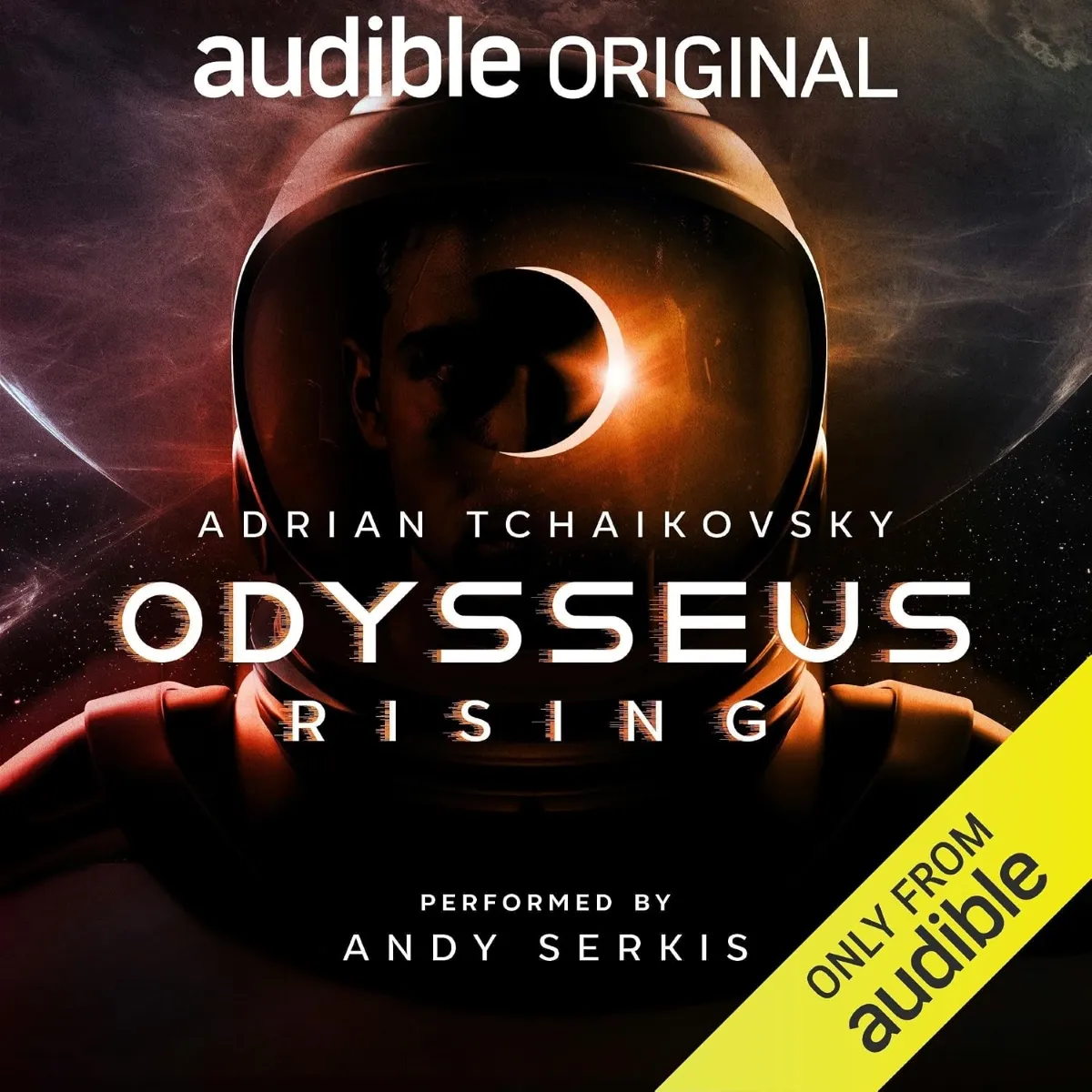
The Audible cover for Odysseus Rising channels a cosmic journey inward — a visual echo of Tchaikovsky’s reimagining of the classic, where self‑discovery unfolds against an interstellar backdrop. Credit: Amazon/Audible
What distinguishes this from the long catalogue of Odyssey retellings — from Ulysses 31 to O Brother, Where Art Thou? to Margaret Atwood's The Penelopiad — is Tchaikovsky's method. He is not borrowing Homer's plot as a convenient scaffold for unrelated space opera. He is treating the Odyssey as a genuine technology: a narrative engine designed to test what homecoming means when the home you left no longer exists, when the person returning is not the person who departed, and when the journey itself has been so prolonged that memory becomes indistinguishable from mythology.
This is territory Tchaikovsky has explored before. In Children of Time, he asked what intelligence might emerge if evolution were given millennia and a different biological substrate. In Shards of Earth, he constructed an alien species — the Architects — so incomprehensibly vast that human consciousness could only encounter them as religious terror. Odysseus Rising applies the same rigorous speculative imagination to the oldest story in Western literature. The question is not whether Homer would recognise his characters. It is whether Homer would recognise his questions — and the answer, based on Tchaikovsky's previous work, is likely to be yes, rendered with an precision that the bard himself might have envied.
Serkis as Narrator: Why the Voice Matters
The announcement that Andy Serkis will narrate is not a celebrity garnish. It is a structural decision. Serkis has spent the better part of three decades solving a problem that Odysseus Rising will face in every chapter: how to make a non-human or transhuman consciousness feel emotionally legible. His Gollum was not a special effect. It was a performance so committed that it forced the Academy to reconsider its entire category system. His Caesar carried the arc of a revolutionary leader across three films without a single line of dialogue that was not subtitled. His Snoke — whatever one thinks of the narrative surrounding the character — was a masterclass in vocal menace, conveying power and fragility in the same breath.
Deadline's original announcement notes that Serkis will voice characters from both the original mythological source and Tchaikovsky's new interpretations. This suggests a multi-layered performance in which the ancient and the futuristic are not separated but braided — a vocal technique that mirrors the novel's own interweaving of classical reference and speculative invention. Serkis, in his own statement to the press, described Tchaikovsky's reimagining as "a staggering act of ingenuity that provides the ancient story with new life and meaning." That enthusiasm matters. In an audio medium where the narrator is the entire production design, casting an actor who genuinely comprehends the material's ambition is not a luxury. It is a necessity.
The Audible Bet: What This Means for Space Sci-Fi Audio Drama
Audible's investment in Odysseus Rising signals something broader about the platform's strategy — and about the state of space sci-fi publishing in 2026. The audiobook market is no longer a secondary format for literary fiction. In speculative genres, it has become a primary revenue stream. Audible's Originals programme, which commissions exclusive content directly, has shifted from experimental to essential. The platform is not merely acquiring rights to existing novels. It is funding productions that could not exist in print — multi-voice, sound-designed, spatial audio experiences that treat narrative as an acoustic event rather than a textual one.
The Dolby Atmos specification for Odysseus Rising is particularly significant. Spatial audio in storytelling is not new — the BBC has been producing binaural dramas for decades — but the commercial scale of an Audible Original with this technology marks a new threshold. For space sci-fi, a genre defined by scale, distance, and the terror of the void, the acoustic dimension is not ornamental. It is thematic. The emptiness between stars, the claustrophobia of a besieged starship, the vertigo of encountering a power that operates on timescales beyond human comprehension — all of these translate to sound in ways that prose, however skilled, can only approximate.
Primetime's feature on the project frames the collaboration as "a major event in audio storytelling, arriving at a time of renewed public interest in Homer's classic work." That timing is not accidental. The past eighteen months have seen a surge in classical adaptation across media — from the Coen brothers' The Odyssey film (announced for 2027) to the BBC's Troy miniseries to Pat Barker's The Women of Troy on stage. Audible is positioning Odysseus Rising not as a niche genre experiment but as a mainstream cultural event with space sci-fi credentials.
The Bigger Lens: Why 2027 Needs This Story
The commercial logic is clear. But the cultural logic is more interesting. Space sci-fi in 2026 has been dominated by franchise extensions — Dune, Star Trek, Blade Runner, The Expanse — and by the expansion of existing properties into new media. What has been comparatively scarce is original speculative fiction that arrives without pre-existing audience recognition and demands to be judged on its own terms. Odysseus Rising occupies a paradoxical position: it is simultaneously the most classical and the most original major space sci-fi release of early 2027. Everyone knows the source material. No one knows what Tchaikovsky has made of it.
This is where the "Ones to Watch" designation carries its weight. SciNexic's franchise series is reserved for projects that demonstrate the capacity to reshape the genre's boundaries — not through budget or marketing muscle, but through creative ambition that exceeds the market's current assumptions. Tchaikovsky's record supports the bet. He is an author who has repeatedly taken premises that sound like elevator pitches (spiders evolve intelligence, a man pilots a ship made of alien bone, the last human soldiers hunt planet-destroying gods) and transformed them into fiction of genuine philosophical weight. Serkis's record supports the bet. Audible's production investment supports the bet.
The remaining variable is timing. Odysseus Rising arrives in February 2027 — a month that, at this distance, looks relatively uncluttered for major space sci-fi literary releases. It will follow the December theatrical onslaught (Dune: Part Three, The Mandalorian & Grogu) and precede the spring television season. In that window, it has the opportunity to capture attention that might otherwise be fragmented. The question is whether Audible will market it as a literary event or hide it behind algorithmic recommendations. Based on the calibre of the creative team and the scale of the production, the former seems not only possible but probable.
For SciNexic, Odysseus Rising represents something we have been tracking all year: the emergence of audio as a prestige format for space sci-fi storytelling. The novel is not dead. The screen is not the only destination. Sometimes the most ambitious journeys happen in the dark, with nothing but a voice and the imagination to guide you. In February 2027, that voice will be Andy Serkis's. The imagination will be Adrian Tchaikovsky's. The destination is worth waiting for.
SciNexic.com may earn a commission through affiliate links, ensuring continued cosmic content.
Some creative partnerships announce themselves with press-release fanfare and vanish into the content churn before the year is out. Others carry the quiet weight of inevitability — the sense that two artists have found the exact project that only they could make together. Odysseus Rising, the Audible Original arriving on 25 February 2027, belongs to the second category. Adrian Tchaikovsky, the British author whose Children of Time trilogy redefined what intelligent alien life could look like in contemporary space sci-fi, has spent the last three years rewriting Homer's 3,000-year-old epic as an interstellar voyage of war, exile, and homecoming. Andy Serkis, the performer who gave digital flesh to Gollum, Caesar, and Snoke, will narrate. The result is not an audiobook in the conventional sense. It is a Dolby Atmos cinematic audio experience — and it may be the most significant space sci-fi literary event of early 2027.
The Ithaca in the Stars: What Tchaikovsky Reimagines
The premise is deceptively simple. The decade-long Siege of Ilium has ended. The world lies in ruins. The starship Ithaca, besieged by oligarchs and corporate parasites, awaits the return of its captain — Odysseus — while its crew navigates a solar system where the "gods" are closer to transhuman aristocrats wielding engineered power than to the capricious deities of the Aegean. As Odysseus journeys home, he faces opposition that transcends space and delves into time itself.
The Audible cover for Odysseus Rising channels a cosmic journey inward — a visual echo of Tchaikovsky’s reimagining of the classic, where self‑discovery unfolds against an interstellar backdrop. Credit: Amazon/Audible
What distinguishes this from the long catalogue of Odyssey retellings — from Ulysses 31 to O Brother, Where Art Thou? to Margaret Atwood's The Penelopiad — is Tchaikovsky's method. He is not borrowing Homer's plot as a convenient scaffold for unrelated space opera. He is treating the Odyssey as a genuine technology: a narrative engine designed to test what homecoming means when the home you left no longer exists, when the person returning is not the person who departed, and when the journey itself has been so prolonged that memory becomes indistinguishable from mythology.
This is territory Tchaikovsky has explored before. In Children of Time, he asked what intelligence might emerge if evolution were given millennia and a different biological substrate. In Shards of Earth, he constructed an alien species — the Architects — so incomprehensibly vast that human consciousness could only encounter them as religious terror. Odysseus Rising applies the same rigorous speculative imagination to the oldest story in Western literature. The question is not whether Homer would recognise his characters. It is whether Homer would recognise his questions — and the answer, based on Tchaikovsky's previous work, is likely to be yes, rendered with an precision that the bard himself might have envied.
Serkis as Narrator: Why the Voice Matters
The announcement that Andy Serkis will narrate is not a celebrity garnish. It is a structural decision. Serkis has spent the better part of three decades solving a problem that Odysseus Rising will face in every chapter: how to make a non-human or transhuman consciousness feel emotionally legible. His Gollum was not a special effect. It was a performance so committed that it forced the Academy to reconsider its entire category system. His Caesar carried the arc of a revolutionary leader across three films without a single line of dialogue that was not subtitled. His Snoke — whatever one thinks of the narrative surrounding the character — was a masterclass in vocal menace, conveying power and fragility in the same breath.
Deadline's original announcement notes that Serkis will voice characters from both the original mythological source and Tchaikovsky's new interpretations. This suggests a multi-layered performance in which the ancient and the futuristic are not separated but braided — a vocal technique that mirrors the novel's own interweaving of classical reference and speculative invention. Serkis, in his own statement to the press, described Tchaikovsky's reimagining as "a staggering act of ingenuity that provides the ancient story with new life and meaning." That enthusiasm matters. In an audio medium where the narrator is the entire production design, casting an actor who genuinely comprehends the material's ambition is not a luxury. It is a necessity.
The Audible Bet: What This Means for Space Sci-Fi Audio Drama
Audible's investment in Odysseus Rising signals something broader about the platform's strategy — and about the state of space sci-fi publishing in 2026. The audiobook market is no longer a secondary format for literary fiction. In speculative genres, it has become a primary revenue stream. Audible's Originals programme, which commissions exclusive content directly, has shifted from experimental to essential. The platform is not merely acquiring rights to existing novels. It is funding productions that could not exist in print — multi-voice, sound-designed, spatial audio experiences that treat narrative as an acoustic event rather than a textual one.
The Dolby Atmos specification for Odysseus Rising is particularly significant. Spatial audio in storytelling is not new — the BBC has been producing binaural dramas for decades — but the commercial scale of an Audible Original with this technology marks a new threshold. For space sci-fi, a genre defined by scale, distance, and the terror of the void, the acoustic dimension is not ornamental. It is thematic. The emptiness between stars, the claustrophobia of a besieged starship, the vertigo of encountering a power that operates on timescales beyond human comprehension — all of these translate to sound in ways that prose, however skilled, can only approximate.
Primetime's feature on the project frames the collaboration as "a major event in audio storytelling, arriving at a time of renewed public interest in Homer's classic work." That timing is not accidental. The past eighteen months have seen a surge in classical adaptation across media — from the Coen brothers' The Odyssey film (announced for 2027) to the BBC's Troy miniseries to Pat Barker's The Women of Troy on stage. Audible is positioning Odysseus Rising not as a niche genre experiment but as a mainstream cultural event with space sci-fi credentials.
The Bigger Lens: Why 2027 Needs This Story
The commercial logic is clear. But the cultural logic is more interesting. Space sci-fi in 2026 has been dominated by franchise extensions — Dune, Star Trek, Blade Runner, The Expanse — and by the expansion of existing properties into new media. What has been comparatively scarce is original speculative fiction that arrives without pre-existing audience recognition and demands to be judged on its own terms. Odysseus Rising occupies a paradoxical position: it is simultaneously the most classical and the most original major space sci-fi release of early 2027. Everyone knows the source material. No one knows what Tchaikovsky has made of it.
This is where the "Ones to Watch" designation carries its weight. SciNexic's franchise series is reserved for projects that demonstrate the capacity to reshape the genre's boundaries — not through budget or marketing muscle, but through creative ambition that exceeds the market's current assumptions. Tchaikovsky's record supports the bet. He is an author who has repeatedly taken premises that sound like elevator pitches (spiders evolve intelligence, a man pilots a ship made of alien bone, the last human soldiers hunt planet-destroying gods) and transformed them into fiction of genuine philosophical weight. Serkis's record supports the bet. Audible's production investment supports the bet.
The remaining variable is timing. Odysseus Rising arrives in February 2027 — a month that, at this distance, looks relatively uncluttered for major space sci-fi literary releases. It will follow the December theatrical onslaught (Dune: Part Three, The Mandalorian & Grogu) and precede the spring television season. In that window, it has the opportunity to capture attention that might otherwise be fragmented. The question is whether Audible will market it as a literary event or hide it behind algorithmic recommendations. Based on the calibre of the creative team and the scale of the production, the former seems not only possible but probable.
For SciNexic, Odysseus Rising represents something we have been tracking all year: the emergence of audio as a prestige format for space sci-fi storytelling. The novel is not dead. The screen is not the only destination. Sometimes the most ambitious journeys happen in the dark, with nothing but a voice and the imagination to guide you. In February 2027, that voice will be Andy Serkis's. The imagination will be Adrian Tchaikovsky's. The destination is worth waiting for.
SciNexic.com may earn a commission through affiliate links, ensuring continued cosmic content.
Some creative partnerships announce themselves with press-release fanfare and vanish into the content churn before the year is out. Others carry the quiet weight of inevitability — the sense that two artists have found the exact project that only they could make together. Odysseus Rising, the Audible Original arriving on 25 February 2027, belongs to the second category. Adrian Tchaikovsky, the British author whose Children of Time trilogy redefined what intelligent alien life could look like in contemporary space sci-fi, has spent the last three years rewriting Homer's 3,000-year-old epic as an interstellar voyage of war, exile, and homecoming. Andy Serkis, the performer who gave digital flesh to Gollum, Caesar, and Snoke, will narrate. The result is not an audiobook in the conventional sense. It is a Dolby Atmos cinematic audio experience — and it may be the most significant space sci-fi literary event of early 2027.
The Ithaca in the Stars: What Tchaikovsky Reimagines
The premise is deceptively simple. The decade-long Siege of Ilium has ended. The world lies in ruins. The starship Ithaca, besieged by oligarchs and corporate parasites, awaits the return of its captain — Odysseus — while its crew navigates a solar system where the "gods" are closer to transhuman aristocrats wielding engineered power than to the capricious deities of the Aegean. As Odysseus journeys home, he faces opposition that transcends space and delves into time itself.
The Audible cover for Odysseus Rising channels a cosmic journey inward — a visual echo of Tchaikovsky’s reimagining of the classic, where self‑discovery unfolds against an interstellar backdrop. Credit: Amazon/Audible
What distinguishes this from the long catalogue of Odyssey retellings — from Ulysses 31 to O Brother, Where Art Thou? to Margaret Atwood's The Penelopiad — is Tchaikovsky's method. He is not borrowing Homer's plot as a convenient scaffold for unrelated space opera. He is treating the Odyssey as a genuine technology: a narrative engine designed to test what homecoming means when the home you left no longer exists, when the person returning is not the person who departed, and when the journey itself has been so prolonged that memory becomes indistinguishable from mythology.
This is territory Tchaikovsky has explored before. In Children of Time, he asked what intelligence might emerge if evolution were given millennia and a different biological substrate. In Shards of Earth, he constructed an alien species — the Architects — so incomprehensibly vast that human consciousness could only encounter them as religious terror. Odysseus Rising applies the same rigorous speculative imagination to the oldest story in Western literature. The question is not whether Homer would recognise his characters. It is whether Homer would recognise his questions — and the answer, based on Tchaikovsky's previous work, is likely to be yes, rendered with an precision that the bard himself might have envied.
Serkis as Narrator: Why the Voice Matters
The announcement that Andy Serkis will narrate is not a celebrity garnish. It is a structural decision. Serkis has spent the better part of three decades solving a problem that Odysseus Rising will face in every chapter: how to make a non-human or transhuman consciousness feel emotionally legible. His Gollum was not a special effect. It was a performance so committed that it forced the Academy to reconsider its entire category system. His Caesar carried the arc of a revolutionary leader across three films without a single line of dialogue that was not subtitled. His Snoke — whatever one thinks of the narrative surrounding the character — was a masterclass in vocal menace, conveying power and fragility in the same breath.
Deadline's original announcement notes that Serkis will voice characters from both the original mythological source and Tchaikovsky's new interpretations. This suggests a multi-layered performance in which the ancient and the futuristic are not separated but braided — a vocal technique that mirrors the novel's own interweaving of classical reference and speculative invention. Serkis, in his own statement to the press, described Tchaikovsky's reimagining as "a staggering act of ingenuity that provides the ancient story with new life and meaning." That enthusiasm matters. In an audio medium where the narrator is the entire production design, casting an actor who genuinely comprehends the material's ambition is not a luxury. It is a necessity.
The Audible Bet: What This Means for Space Sci-Fi Audio Drama
Audible's investment in Odysseus Rising signals something broader about the platform's strategy — and about the state of space sci-fi publishing in 2026. The audiobook market is no longer a secondary format for literary fiction. In speculative genres, it has become a primary revenue stream. Audible's Originals programme, which commissions exclusive content directly, has shifted from experimental to essential. The platform is not merely acquiring rights to existing novels. It is funding productions that could not exist in print — multi-voice, sound-designed, spatial audio experiences that treat narrative as an acoustic event rather than a textual one.
The Dolby Atmos specification for Odysseus Rising is particularly significant. Spatial audio in storytelling is not new — the BBC has been producing binaural dramas for decades — but the commercial scale of an Audible Original with this technology marks a new threshold. For space sci-fi, a genre defined by scale, distance, and the terror of the void, the acoustic dimension is not ornamental. It is thematic. The emptiness between stars, the claustrophobia of a besieged starship, the vertigo of encountering a power that operates on timescales beyond human comprehension — all of these translate to sound in ways that prose, however skilled, can only approximate.
Primetime's feature on the project frames the collaboration as "a major event in audio storytelling, arriving at a time of renewed public interest in Homer's classic work." That timing is not accidental. The past eighteen months have seen a surge in classical adaptation across media — from the Coen brothers' The Odyssey film (announced for 2027) to the BBC's Troy miniseries to Pat Barker's The Women of Troy on stage. Audible is positioning Odysseus Rising not as a niche genre experiment but as a mainstream cultural event with space sci-fi credentials.
The Bigger Lens: Why 2027 Needs This Story
The commercial logic is clear. But the cultural logic is more interesting. Space sci-fi in 2026 has been dominated by franchise extensions — Dune, Star Trek, Blade Runner, The Expanse — and by the expansion of existing properties into new media. What has been comparatively scarce is original speculative fiction that arrives without pre-existing audience recognition and demands to be judged on its own terms. Odysseus Rising occupies a paradoxical position: it is simultaneously the most classical and the most original major space sci-fi release of early 2027. Everyone knows the source material. No one knows what Tchaikovsky has made of it.
This is where the "Ones to Watch" designation carries its weight. SciNexic's franchise series is reserved for projects that demonstrate the capacity to reshape the genre's boundaries — not through budget or marketing muscle, but through creative ambition that exceeds the market's current assumptions. Tchaikovsky's record supports the bet. He is an author who has repeatedly taken premises that sound like elevator pitches (spiders evolve intelligence, a man pilots a ship made of alien bone, the last human soldiers hunt planet-destroying gods) and transformed them into fiction of genuine philosophical weight. Serkis's record supports the bet. Audible's production investment supports the bet.
The remaining variable is timing. Odysseus Rising arrives in February 2027 — a month that, at this distance, looks relatively uncluttered for major space sci-fi literary releases. It will follow the December theatrical onslaught (Dune: Part Three, The Mandalorian & Grogu) and precede the spring television season. In that window, it has the opportunity to capture attention that might otherwise be fragmented. The question is whether Audible will market it as a literary event or hide it behind algorithmic recommendations. Based on the calibre of the creative team and the scale of the production, the former seems not only possible but probable.
For SciNexic, Odysseus Rising represents something we have been tracking all year: the emergence of audio as a prestige format for space sci-fi storytelling. The novel is not dead. The screen is not the only destination. Sometimes the most ambitious journeys happen in the dark, with nothing but a voice and the imagination to guide you. In February 2027, that voice will be Andy Serkis's. The imagination will be Adrian Tchaikovsky's. The destination is worth waiting for.
SciNexic.com may earn a commission through affiliate links, ensuring continued cosmic content.
Image Gallery
Comments
Please be kind and considerate. Any abusive or offensive comments will be sent out the airlock! Thank You.
Please be kind and considerate. Any abusive or offensive comments will be sent out the airlock! Thank You.
Join the SciNexic Crew
Related Posts
Share on Instagram
Share on Instagram
Banner Image - Andy Serkis & Adrian Tchaikovsky images - Wikimedia
Main Article - All images and media are the property of their respective owners.