


The SciNexic Files
The SciNexic Files
The SciNexic Files
Feature
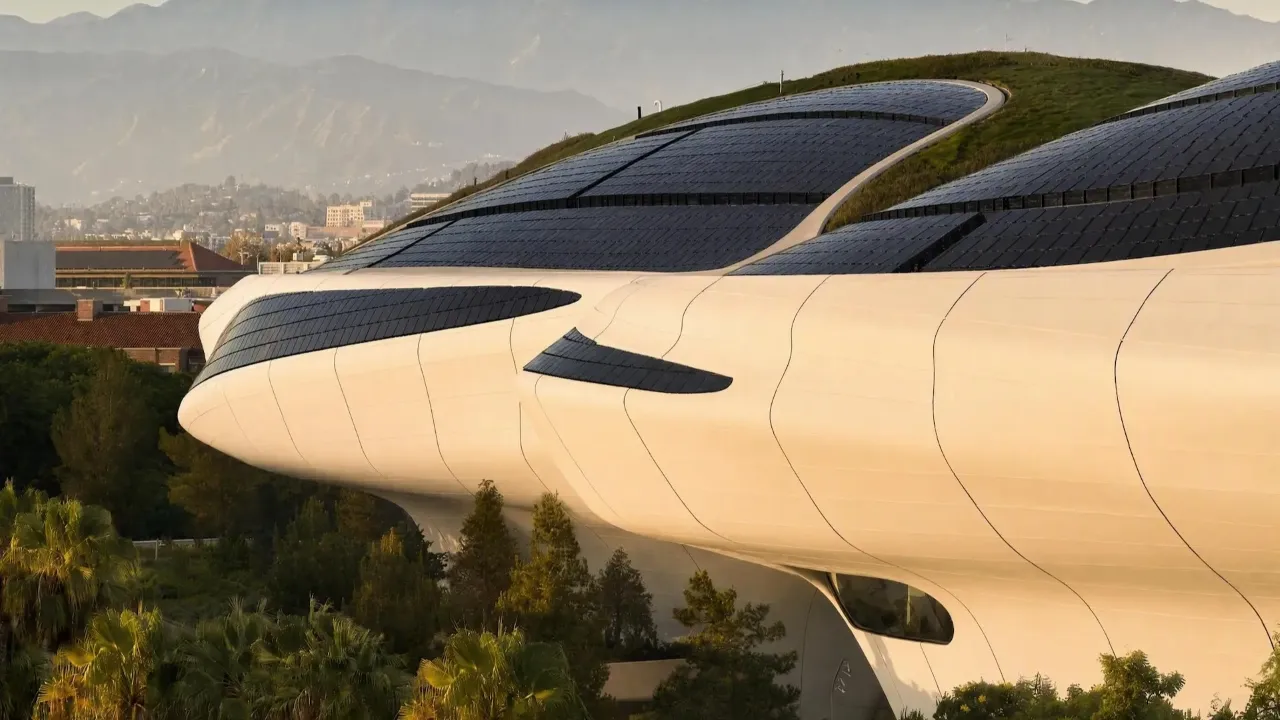
The Lucas Museum of Narrative Art: Where Space Sci-Fi Meets the History of Visual Storytelling
The Lucas Museum of Narrative Art: Where Space Sci-Fi Meets the History of Visual Storytelling
Space sci‑fi’s boldest ideas don’t always come from distant galaxies — sometimes they come from a filmmaker obsessed with preserving the art that shaped him. After decades of planning, the Lucas Museum of Narrative Art finally opened on 22 September 2026, unveiling a 300,000‑square‑foot tribute to the power of visual storytelling. It’s not just a celebration of George Lucas’s legacy; it’s a statement that every image — from ancient cave paintings to the worlds of Star Wars — is part of humanity’s oldest and most enduring creative language.
For space sci-fi fans, it is unmissable.
A New Hope: The Museum That Almost Wasn't
The Lucas Museum's journey to Exposition Park is itself a story worthy of a space opera. After years of planning, a failed bid to build in San Francisco, and a protracted battle over a proposed Chicago lakefront site, Lucas and his wife Mellody Hobson ultimately chose Los Angeles — a city whose relationship with cinema is as old as the medium itself. The result is a building that looks, from the outside, like something that landed rather than was constructed.
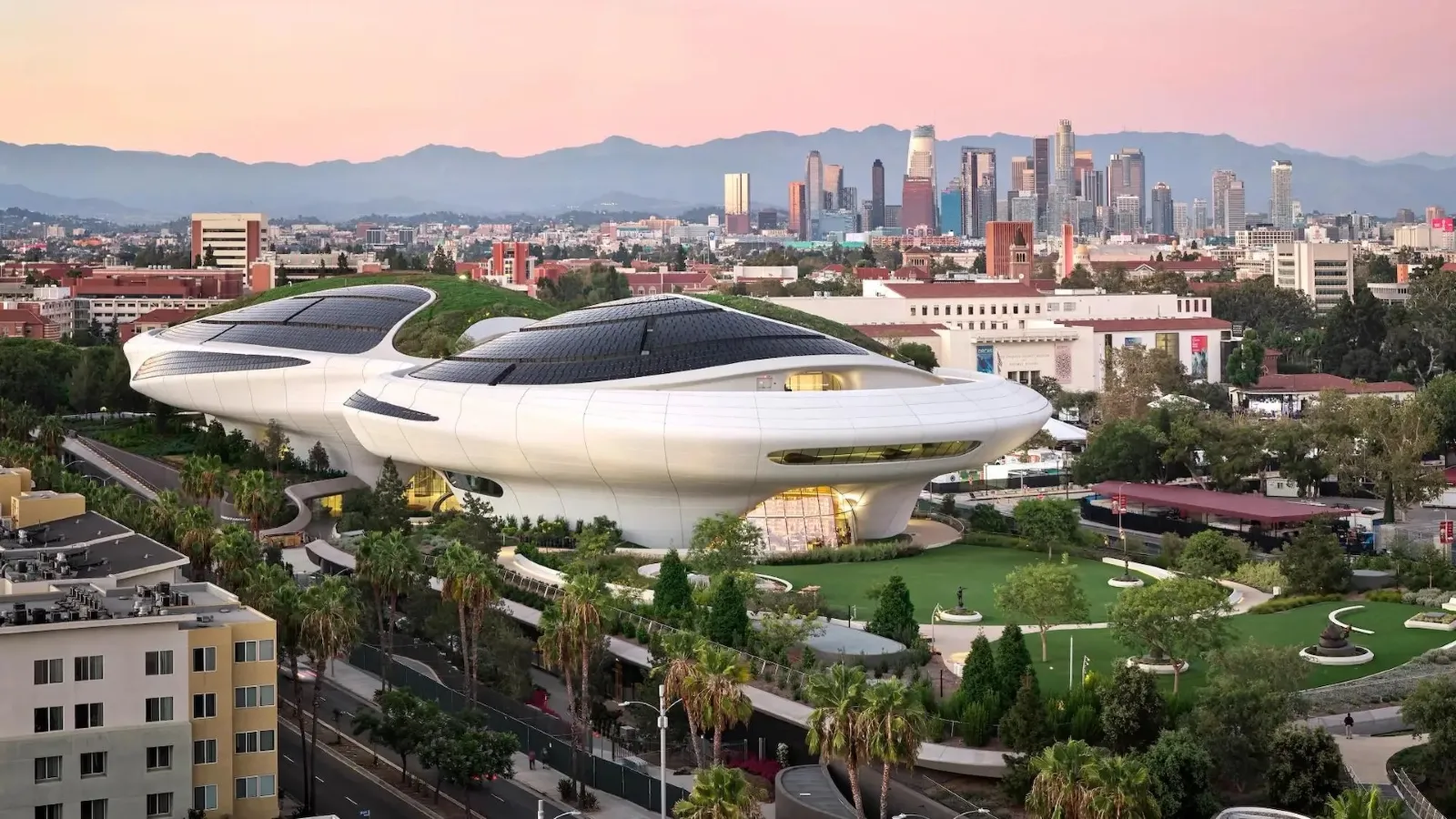
Fluid lines, lifted plazas, and a sky‑bound oculus: the Lucas Museum redefines what a narrative space can be. Credit: MAD Architects
Designed by Ma Yansong of MAD Architects with Stantec, the structure is clad in over 1,200 unique fiberglass-reinforced polymer panels, giving it a fluid, organic silhouette that has already drawn comparisons to a spacecraft. The surrounding 13-acre campus, designed by Mia Lehrer of Studio-MLA, replaces a former asphalt car park with indigenous plantings, a meadow, an amphitheatre, and a waterfall. Ten monumental outdoor sculptures — including depictions of Princess Leia and Yoda — greet visitors before they've even crossed the threshold.
This is space sci-fi as civic architecture. And it works.
The Force Awakens: What's Inside
The museum houses a collection of more than 40,000 works spanning painting, illustration, comic art, photography, and cinema. The inaugural exhibitions span over 100,000 square feet across more than 30 galleries, tracing the history of visual storytelling from ancient times to the present day. Works by Norman Rockwell, Diego Rivera, Banksy, and Judith F. Baca sit alongside a significant archive of African American film history — a reminder that narrative art has always been a site of cultural power and contestation.
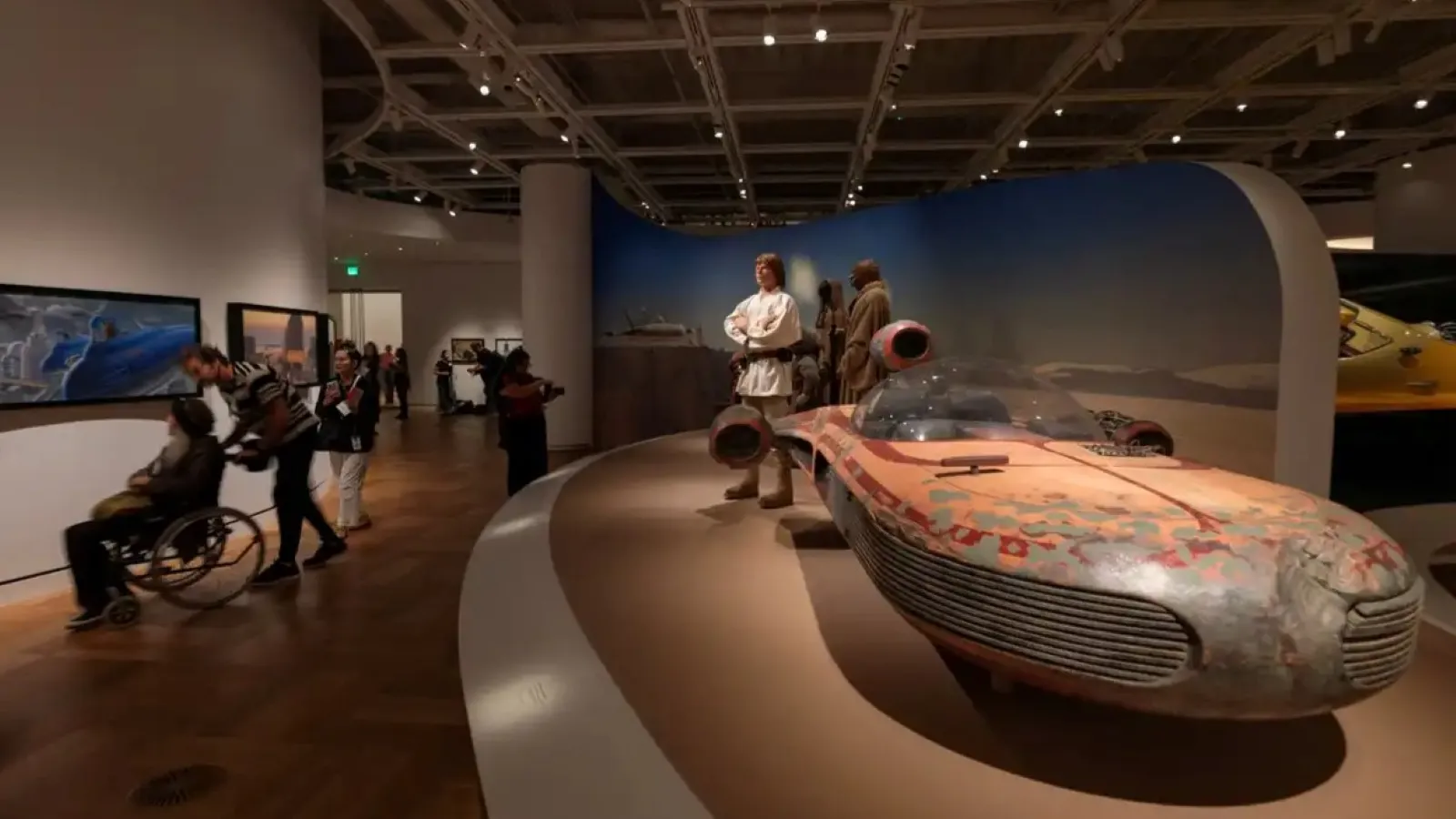
From Luke Skywalker's landspeeder to franchise legends — Star Wars comes alive through the vehicles, props, and worlds that shaped cinema. Credit:USAtoday.com
For space sci-fi devotees, the centrepiece is the Star Wars in Motion exhibition, housed within the cinema gallery. As confirmed by the museum's official press release, the exhibition focuses on the land vehicles, props, and costumes from the original and prequel trilogies. Confirmed highlights include:
Luke Skywalker's X-34 Landspeeder (A New Hope)
General Grievous's Wheel Bike (Revenge of the Sith)
R2-D2, C-3PO, Darth Vader's suit, and podracers from across the saga
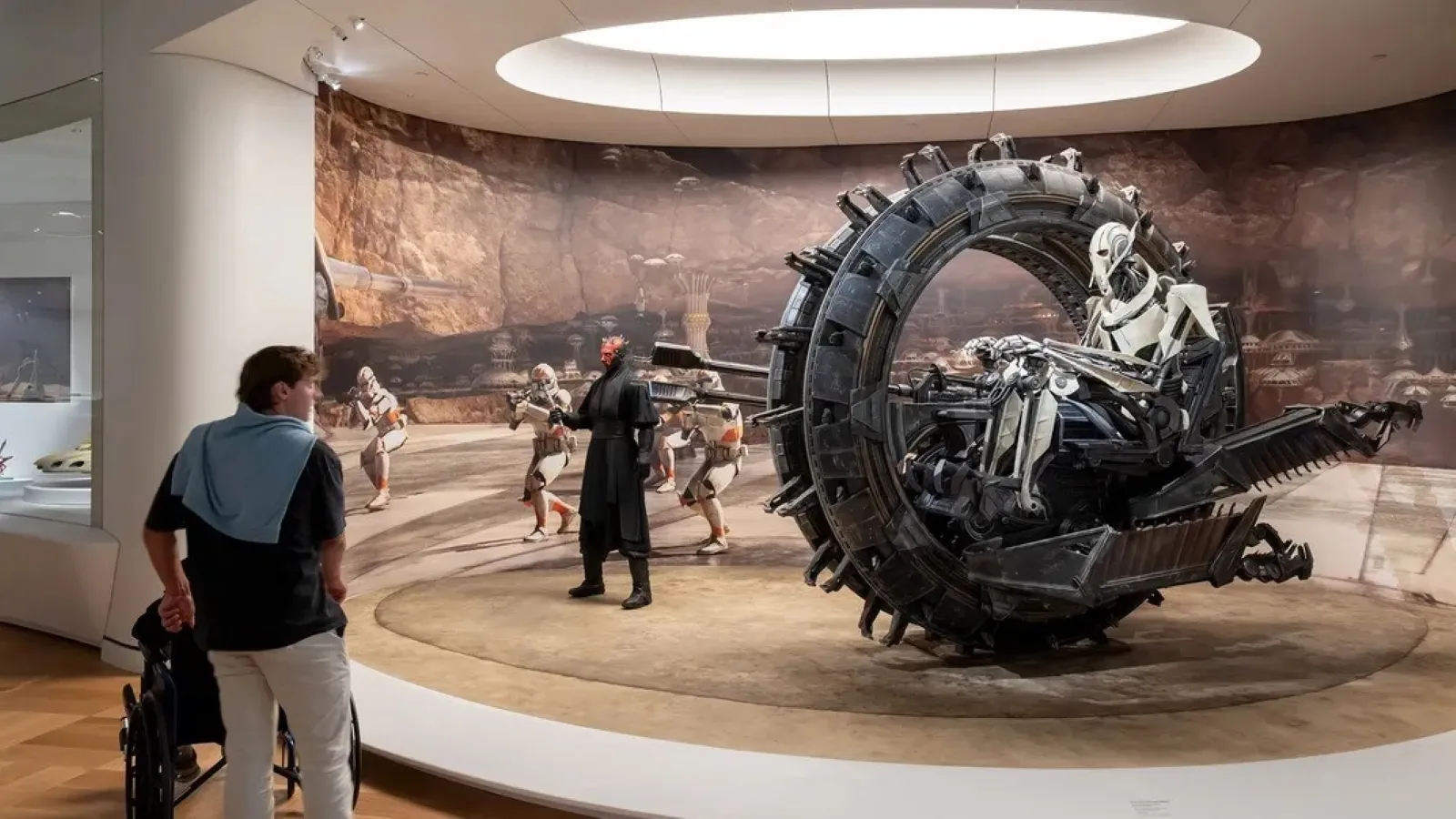
Star Wars in Motion featuring Grievous's Wheel Bike — a kinetic tribute to the craft behind speed, spectacle, and storytelling. Credit: Iwan Baan/wdwnt.com
These are not replicas. These are the actual artefacts — the physical objects that defined a generation's imagination of what space travel, alien worlds, and the future might look like. Standing next to the Landspeeder that Luke drove across the Tatooine desert is, for any space sci-fi fan, a genuinely transcendent experience.
The museum also houses the complete Lucas Archives (1971–2012), offering an unprecedented window into the creative process behind some of the most influential space sci-fi ever committed to film.
The Prize That Changes Everything: Why This Matters for Space Sci-Fi Culture
The Lucas Museum is more than a tourist attraction. It is a cultural argument — one that positions space sci-fi not as escapism, but as a legitimate and vital form of narrative art. By placing Star Wars alongside Norman Rockwell and Diego Rivera, Lucas is making a claim that has always been implicit in the best science fiction: that stories about the cosmos are stories about us.
"Narrative art is the oldest form of human communication. It's how we make sense of the world, how we pass on our values, how we dream." — George Lucas, speaking at the museum's opening ceremony.
This framing matters enormously for how space sci-fi is perceived and valued. For decades, the genre has fought for critical legitimacy — dismissed as popcorn entertainment even as it grappled with questions of identity, power, technology, and the human condition. A museum of this scale and ambition, built by the creator of Star Wars, is a powerful statement that those battles are over.
Visiting the Museum: Practical Details
According to the museum's official visitor information, all visitors must book timed-entry tickets in advance — there is no walk-in entry. Admission pricing is as follows:
Adults: £19 (approx. $25 USD)
Seniors (65+): £16 (approx. $21 USD)
Children (17 and under): Free
Active-Duty Military: Free
The museum is located at One Lucas Plaza, Exposition Park, Los Angeles, and is accessible via the Metro E Line (Expo/Vermont station). It is open Monday, Wednesday, and Thursday from 10am–5pm; Friday from 10am–9pm; Saturday from 9am–9pm; and Sunday from 9am–5pm. It is closed on Tuesdays.
The campus also features the Skywalker Grill restaurant and a first-floor café, as well as a free public research library containing rare books, comic books, and personal archives from figures including Joseph Campbell — the mythologist whose work on the hero's journey directly shaped Star Wars.
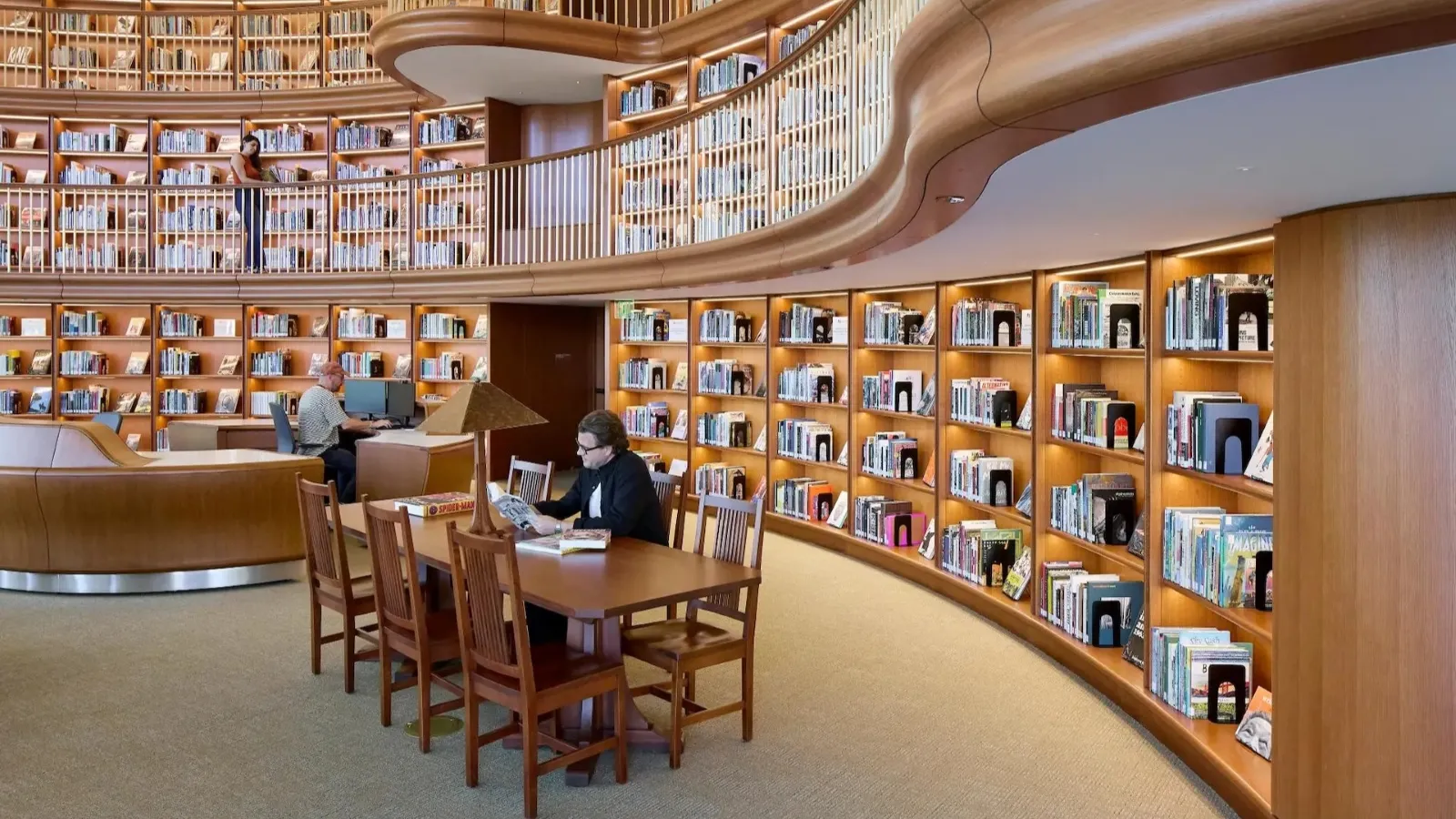
The public research library offers a journey through 1,300 works that reveal how stories connect us, challenge us, and define us. Credit: MAD Architects
A Stellar Statement
The Lucas Museum of Narrative Art is the most significant cultural institution dedicated to the art of visual storytelling to open in a generation — and for space sci-fi fans, it is a pilgrimage site. Whether you're drawn by the Star Wars in Motion exhibition, the breadth of the permanent collection, or simply the extraordinary building itself, this is a museum that takes the stories we love seriously. It argues, with considerable force, that the galaxy far, far away is part of a much longer human tradition of looking up at the stars and asking: what if? If you're anywhere near Los Angeles, suit up and make the journey. The Force — and the art — will be with you.
Are you planning to visit the museum? Let us know your views in the comments.
Keep your scanners locked on Scinexic.com for more recommendations, and the latest in interstellar viewing.
Further Reading:
Space sci‑fi’s boldest ideas don’t always come from distant galaxies — sometimes they come from a filmmaker obsessed with preserving the art that shaped him. After decades of planning, the Lucas Museum of Narrative Art finally opened on 22 September 2026, unveiling a 300,000‑square‑foot tribute to the power of visual storytelling. It’s not just a celebration of George Lucas’s legacy; it’s a statement that every image — from ancient cave paintings to the worlds of Star Wars — is part of humanity’s oldest and most enduring creative language.
For space sci-fi fans, it is unmissable.
A New Hope: The Museum That Almost Wasn't
The Lucas Museum's journey to Exposition Park is itself a story worthy of a space opera. After years of planning, a failed bid to build in San Francisco, and a protracted battle over a proposed Chicago lakefront site, Lucas and his wife Mellody Hobson ultimately chose Los Angeles — a city whose relationship with cinema is as old as the medium itself. The result is a building that looks, from the outside, like something that landed rather than was constructed.
Fluid lines, lifted plazas, and a sky‑bound oculus: the Lucas Museum redefines what a narrative space can be. Credit: MAD Architects
Designed by Ma Yansong of MAD Architects with Stantec, the structure is clad in over 1,200 unique fiberglass-reinforced polymer panels, giving it a fluid, organic silhouette that has already drawn comparisons to a spacecraft. The surrounding 13-acre campus, designed by Mia Lehrer of Studio-MLA, replaces a former asphalt car park with indigenous plantings, a meadow, an amphitheatre, and a waterfall. Ten monumental outdoor sculptures — including depictions of Princess Leia and Yoda — greet visitors before they've even crossed the threshold.
This is space sci-fi as civic architecture. And it works.
The Force Awakens: What's Inside
The museum houses a collection of more than 40,000 works spanning painting, illustration, comic art, photography, and cinema. The inaugural exhibitions span over 100,000 square feet across more than 30 galleries, tracing the history of visual storytelling from ancient times to the present day. Works by Norman Rockwell, Diego Rivera, Banksy, and Judith F. Baca sit alongside a significant archive of African American film history — a reminder that narrative art has always been a site of cultural power and contestation.
From Luke Skywalker's landspeeder to franchise legends — Star Wars comes alive through the vehicles, props, and worlds that shaped cinema. Credit:USAtoday.com
For space sci-fi devotees, the centrepiece is the Star Wars in Motion exhibition, housed within the cinema gallery. As confirmed by the museum's official press release, the exhibition focuses on the land vehicles, props, and costumes from the original and prequel trilogies. Confirmed highlights include:
Luke Skywalker's X-34 Landspeeder (A New Hope)
General Grievous's Wheel Bike (Revenge of the Sith)
R2-D2, C-3PO, Darth Vader's suit, and podracers from across the saga
Star Wars in Motion featuring Grievous's Wheel Bike — a kinetic tribute to the craft behind speed, spectacle, and storytelling. Credit: Iwan Baan/wdwnt.com
These are not replicas. These are the actual artefacts — the physical objects that defined a generation's imagination of what space travel, alien worlds, and the future might look like. Standing next to the Landspeeder that Luke drove across the Tatooine desert is, for any space sci-fi fan, a genuinely transcendent experience.
The museum also houses the complete Lucas Archives (1971–2012), offering an unprecedented window into the creative process behind some of the most influential space sci-fi ever committed to film.
The Prize That Changes Everything: Why This Matters for Space Sci-Fi Culture
The Lucas Museum is more than a tourist attraction. It is a cultural argument — one that positions space sci-fi not as escapism, but as a legitimate and vital form of narrative art. By placing Star Wars alongside Norman Rockwell and Diego Rivera, Lucas is making a claim that has always been implicit in the best science fiction: that stories about the cosmos are stories about us.
"Narrative art is the oldest form of human communication. It's how we make sense of the world, how we pass on our values, how we dream." — George Lucas, speaking at the museum's opening ceremony.
This framing matters enormously for how space sci-fi is perceived and valued. For decades, the genre has fought for critical legitimacy — dismissed as popcorn entertainment even as it grappled with questions of identity, power, technology, and the human condition. A museum of this scale and ambition, built by the creator of Star Wars, is a powerful statement that those battles are over.
Visiting the Museum: Practical Details
According to the museum's official visitor information, all visitors must book timed-entry tickets in advance — there is no walk-in entry. Admission pricing is as follows:
Adults: £19 (approx. $25 USD)
Seniors (65+): £16 (approx. $21 USD)
Children (17 and under): Free
Active-Duty Military: Free
The museum is located at One Lucas Plaza, Exposition Park, Los Angeles, and is accessible via the Metro E Line (Expo/Vermont station). It is open Monday, Wednesday, and Thursday from 10am–5pm; Friday from 10am–9pm; Saturday from 9am–9pm; and Sunday from 9am–5pm. It is closed on Tuesdays.
The campus also features the Skywalker Grill restaurant and a first-floor café, as well as a free public research library containing rare books, comic books, and personal archives from figures including Joseph Campbell — the mythologist whose work on the hero's journey directly shaped Star Wars.
The public research library offers a journey through 1,300 works that reveal how stories connect us, challenge us, and define us. Credit: MAD Architects
A Stellar Statement
The Lucas Museum of Narrative Art is the most significant cultural institution dedicated to the art of visual storytelling to open in a generation — and for space sci-fi fans, it is a pilgrimage site. Whether you're drawn by the Star Wars in Motion exhibition, the breadth of the permanent collection, or simply the extraordinary building itself, this is a museum that takes the stories we love seriously. It argues, with considerable force, that the galaxy far, far away is part of a much longer human tradition of looking up at the stars and asking: what if? If you're anywhere near Los Angeles, suit up and make the journey. The Force — and the art — will be with you.
Are you planning to visit the museum? Let us know your views in the comments.
Keep your scanners locked on Scinexic.com for more recommendations, and the latest in interstellar viewing.
Further Reading:
Space sci‑fi’s boldest ideas don’t always come from distant galaxies — sometimes they come from a filmmaker obsessed with preserving the art that shaped him. After decades of planning, the Lucas Museum of Narrative Art finally opened on 22 September 2026, unveiling a 300,000‑square‑foot tribute to the power of visual storytelling. It’s not just a celebration of George Lucas’s legacy; it’s a statement that every image — from ancient cave paintings to the worlds of Star Wars — is part of humanity’s oldest and most enduring creative language.
For space sci-fi fans, it is unmissable.
A New Hope: The Museum That Almost Wasn't
The Lucas Museum's journey to Exposition Park is itself a story worthy of a space opera. After years of planning, a failed bid to build in San Francisco, and a protracted battle over a proposed Chicago lakefront site, Lucas and his wife Mellody Hobson ultimately chose Los Angeles — a city whose relationship with cinema is as old as the medium itself. The result is a building that looks, from the outside, like something that landed rather than was constructed.
Fluid lines, lifted plazas, and a sky‑bound oculus: the Lucas Museum redefines what a narrative space can be. Credit: MAD Architects
Designed by Ma Yansong of MAD Architects with Stantec, the structure is clad in over 1,200 unique fiberglass-reinforced polymer panels, giving it a fluid, organic silhouette that has already drawn comparisons to a spacecraft. The surrounding 13-acre campus, designed by Mia Lehrer of Studio-MLA, replaces a former asphalt car park with indigenous plantings, a meadow, an amphitheatre, and a waterfall. Ten monumental outdoor sculptures — including depictions of Princess Leia and Yoda — greet visitors before they've even crossed the threshold.
This is space sci-fi as civic architecture. And it works.
The Force Awakens: What's Inside
The museum houses a collection of more than 40,000 works spanning painting, illustration, comic art, photography, and cinema. The inaugural exhibitions span over 100,000 square feet across more than 30 galleries, tracing the history of visual storytelling from ancient times to the present day. Works by Norman Rockwell, Diego Rivera, Banksy, and Judith F. Baca sit alongside a significant archive of African American film history — a reminder that narrative art has always been a site of cultural power and contestation.
From Luke Skywalker's landspeeder to franchise legends — Star Wars comes alive through the vehicles, props, and worlds that shaped cinema. Credit:USAtoday.com
For space sci-fi devotees, the centrepiece is the Star Wars in Motion exhibition, housed within the cinema gallery. As confirmed by the museum's official press release, the exhibition focuses on the land vehicles, props, and costumes from the original and prequel trilogies. Confirmed highlights include:
Luke Skywalker's X-34 Landspeeder (A New Hope)
General Grievous's Wheel Bike (Revenge of the Sith)
R2-D2, C-3PO, Darth Vader's suit, and podracers from across the saga
Star Wars in Motion featuring Grievous's Wheel Bike — a kinetic tribute to the craft behind speed, spectacle, and storytelling. Credit: Iwan Baan/wdwnt.com
These are not replicas. These are the actual artefacts — the physical objects that defined a generation's imagination of what space travel, alien worlds, and the future might look like. Standing next to the Landspeeder that Luke drove across the Tatooine desert is, for any space sci-fi fan, a genuinely transcendent experience.
The museum also houses the complete Lucas Archives (1971–2012), offering an unprecedented window into the creative process behind some of the most influential space sci-fi ever committed to film.
The Prize That Changes Everything: Why This Matters for Space Sci-Fi Culture
The Lucas Museum is more than a tourist attraction. It is a cultural argument — one that positions space sci-fi not as escapism, but as a legitimate and vital form of narrative art. By placing Star Wars alongside Norman Rockwell and Diego Rivera, Lucas is making a claim that has always been implicit in the best science fiction: that stories about the cosmos are stories about us.
"Narrative art is the oldest form of human communication. It's how we make sense of the world, how we pass on our values, how we dream." — George Lucas, speaking at the museum's opening ceremony.
This framing matters enormously for how space sci-fi is perceived and valued. For decades, the genre has fought for critical legitimacy — dismissed as popcorn entertainment even as it grappled with questions of identity, power, technology, and the human condition. A museum of this scale and ambition, built by the creator of Star Wars, is a powerful statement that those battles are over.
Visiting the Museum: Practical Details
According to the museum's official visitor information, all visitors must book timed-entry tickets in advance — there is no walk-in entry. Admission pricing is as follows:
Adults: £19 (approx. $25 USD)
Seniors (65+): £16 (approx. $21 USD)
Children (17 and under): Free
Active-Duty Military: Free
The museum is located at One Lucas Plaza, Exposition Park, Los Angeles, and is accessible via the Metro E Line (Expo/Vermont station). It is open Monday, Wednesday, and Thursday from 10am–5pm; Friday from 10am–9pm; Saturday from 9am–9pm; and Sunday from 9am–5pm. It is closed on Tuesdays.
The campus also features the Skywalker Grill restaurant and a first-floor café, as well as a free public research library containing rare books, comic books, and personal archives from figures including Joseph Campbell — the mythologist whose work on the hero's journey directly shaped Star Wars.
The public research library offers a journey through 1,300 works that reveal how stories connect us, challenge us, and define us. Credit: MAD Architects
A Stellar Statement
The Lucas Museum of Narrative Art is the most significant cultural institution dedicated to the art of visual storytelling to open in a generation — and for space sci-fi fans, it is a pilgrimage site. Whether you're drawn by the Star Wars in Motion exhibition, the breadth of the permanent collection, or simply the extraordinary building itself, this is a museum that takes the stories we love seriously. It argues, with considerable force, that the galaxy far, far away is part of a much longer human tradition of looking up at the stars and asking: what if? If you're anywhere near Los Angeles, suit up and make the journey. The Force — and the art — will be with you.
Are you planning to visit the museum? Let us know your views in the comments.
Keep your scanners locked on Scinexic.com for more recommendations, and the latest in interstellar viewing.
Further Reading:
Image Gallery
Comments
Please be kind and considerate. Any abusive or offensive comments will be sent out the airlock! Thank You.
Please be kind and considerate. Any abusive or offensive comments will be sent out the airlock! Thank You.


Join the SciNexic Crew
Related Posts
Share on Instagram
Share on Instagram
Banner Image - Lucas Museum of Narrative Art image - https://www.i-mad.com/_next/image?url=https%3A%2F%2Fcdn.sanity.io%2Fimages%2F2d8zs6ec%2Fproduction%2F645194ee375e11c8a383b93616eee6671afef21f-2976x2784.png%3Fw%3D2000&w=1920&q=75 - Copyright: MAD Architects
Main Article - All images and media are the property of their respective owners.