


The SciNexic Files
Report

A Real Lava World Wrapped in Impossible Clouds: JWST Finds the Cosmic Fireball Exoplanet That Rewrites Space Sci-Fi's Rulebook
A Planet Where the Ground Glows and the Sky Shouldn't Be There
Beneath a sky of vaporised rock, 280 light-years from Earth, a planet completes its orbit in just ten and a half hours. Surface temperatures breach 1,800°C. Starlight hammers the dayside with enough ferocity to strip any known atmosphere into oblivion. And yet the James Webb Space Telescope has confirmed, across 37 hours of continuous observation, that TOI-561 b keeps its gaseous envelope intact — shielded by clouds made of silicate minerals that reflect roughly 75 per cent of incoming radiation, functioning as a planetary sunscreen the size of a continent.
The discovery from December 2025, which was published this week and framed by Space.com as a "real-life cosmic horror story" just in time for Halloween, is precisely the kind of finding that should make every space sci-fi writer pause mid-sentence and reconsider what they thought they knew about hostile worlds.
Silicon Shields and Magma Oceans: The Science Behind the Fiction
TOI-561 b is a super-Earth — larger and denser than our planet, tidally locked so that one hemisphere faces its star in perpetual daylight while the other sits in permanent shadow. Previous models predicted that any rocky world this close to its host star should have been scoured clean billions of years ago. Instead, JWST phase-curve observations revealed something the models never anticipated: an atmosphere thick enough to redistribute heat, composed largely of silicon dioxide and magnesium silicate.
The leading explanation involves a global magma ocean that continuously vents volcanic gases upward, replenishing the atmosphere as fast as the star strips it away. Researchers at the University of Bern liken the mechanism to an extreme version of Jupiter's moon Io — a planet-wide volcano that never sleeps.
For comparison, Venus reflects about 75 per cent of sunlight too, but achieves this through sulphuric acid clouds at relatively mild temperatures. TOI-561 b does it with molten rock vapour in conditions that would melt tungsten. The difference is not merely academic. It suggests that the boundary between "habitable" and "uninhabitable" is far more permeable than space sci-fi has traditionally assumed.
The Genre's Oldest Assumption, Quietly Demolished
Space sci-fi has long operated on a binary: worlds are either welcoming enough for colony ships or hostile enough to kill in minutes. Arrakis scorches. Hoth freezes. LV-426 corrodes. The environments are extreme, but they are comprehensible — deserts, tundras, acid storms. What TOI-561 b introduces is something altogether stranger: a planet that is hostile in every conceivable metric yet stubbornly, impossibly alive in its atmospheric chemistry.
This is not the "Goldilocks zone" thinking that has dominated both scientific outreach and genre fiction for decades. It is a direct challenge to the assumption that atmospheres require moderate conditions to persist. If a world bathed in 1,800°C starlight can maintain a gaseous shell through sheer volcanic fury, then the range of possible planetary environments in fiction — and in reality — expands dramatically.
Consider the implications for franchises already exploring extreme worlds. The magma seas in Star Wars: Mustafar, the volcanic fury of Star Trek: Discovery's mirror universe, the lethal beauty of Subnautica: Below Zero's alien biomes — all of these drew on a shared assumption that lava worlds are barren, lifeless, and atmospherically naked. TOI-561 b suggests they could be wrapped in reflective clouds that make them shine like beacons across interstellar distances.
What This Means for the Genre's Next Decade
The timing matters. With Dune: Part Three arriving on 18 December, Blade Runner 2099 premiering on 25 November, and NASA's CHAPEA crew emerging from their 378-day Mars simulation today, space sci-fi sits at a confluence of real and fictional exploration that the genre has not experienced since the Apollo era.
TOI-561 b adds a genuinely new ingredient to that mix. It is not a habitable world. It is not a dead one. It is something the genre has barely imagined: a planet that fights its own star to stay dressed in clouds of vaporised stone, powered by a global ocean of liquid rock. The JWST team plans further observations at longer wavelengths to determine whether the atmosphere is volcanic or Venus-like in composition — a distinction that could reshape how writers, game designers, and filmmakers depict hostile exoplanets for the next generation.
The Universe Keeps Outwriting Us
On a night when carved pumpkins glow on doorsteps and cinema screens fill with fictional horrors, the most unsettling thing in the cosmos is not a monster. It is a planet that refuses to obey the rules we wrote for it — a world where the ground is an ocean of magma, the sky is made of rock vapour, and the atmosphere exists only because the planet is angry enough to keep rebuilding it. If that is not the premise of the next great space sci-fi novel, it should be.
Get the SciNexic Dispatch
Space sci-fi news, reviews, trailers, and release picks—straight to your inbox.
Get the dispatch
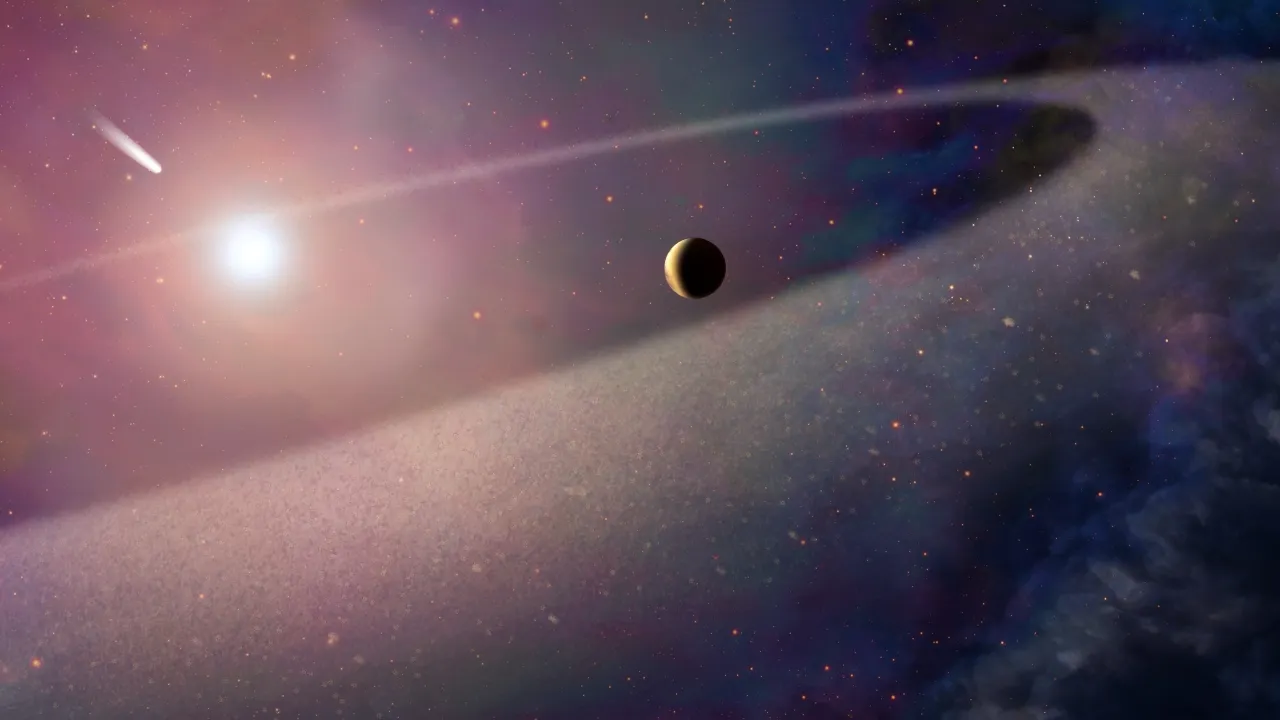
Banner Image - TOI-561 b artists image - https://science.nasa.gov/asset/webb/super-earth-exoplanet-toi-561-b-and-its-star-artists-concept/ - Copyright: NASA