


The SciNexic Files
SciNexic Analysis

Nobody Told the Robot It Was Making History: Caltech's ASTRA Just Built the First Structure in Space Without Human Help — and Space Sci-Fi's Orbital Colonies Inched Closer to Reality
Nobody Told the Robot It Was Making History: Caltech's ASTRA Just Built the First Structure in Space Without Human Help — and Space Sci-Fi's Orbital Colonies Inched Closer to Reality
Every great space station in science fiction — from Babylon 5's five-mile rotating cylinder to the Citadel in Mass Effect to the spinning ring of 2001: A Space Odyssey — shares one quiet assumption: somebody, or something, built it up there. Not folded it into a rocket fairing and hoped it would unfurl correctly, but actually assembled it, beam by beam, in the void. On 5 November 2026, that assumption stopped being fiction.
Researchers at the California Institute of Technology announced that their ASTRA payload — the Autonomous In-Space Tensioned Reflector Assembly — had successfully constructed a structural truss in low-Earth orbit without any human intervention whatsoever. A three-axis gantry robot retrieved composite fibre tubes and aluminium joints from motorised dispensers, snapped them together like futuristic Tinkertoys, attached a sheet of reflective Kapton mesh, and pushed the completed bay out into space before starting the next one. No astronaut touched it. No hand guided it. The robot simply built.
From Fairing Constraints to Orbital Factories
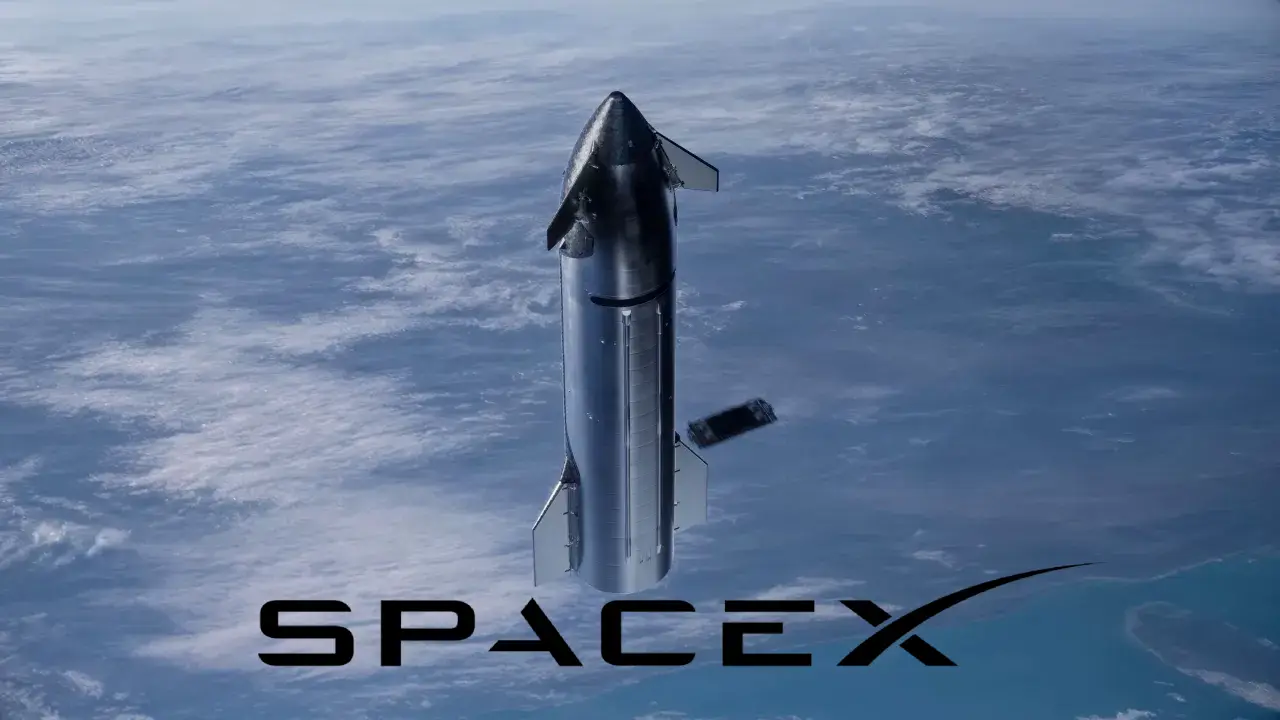
The achievement matters because of a bottleneck that has throttled space infrastructure since Sputnik. Every structure humanity has placed in orbit — the International Space Station, the Hubble Space Telescope, communications satellites — has been limited by the diameter of the rocket fairing that carried it. The largest fairing currently in service, SpaceX's Starship, offers roughly nine metres of internal width. That is impressive for launching cargo, but it is a poor foundation for building anything resembling the kilometre-scale habitats that populate space sci-fi.
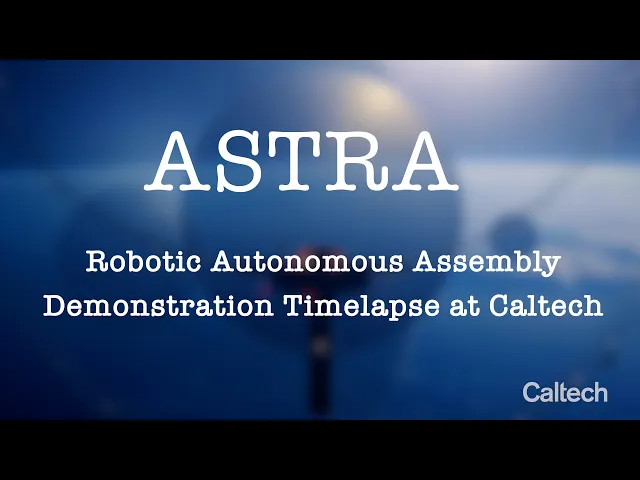
NOM4D – ASTRA Assembly Demonstration. By Caltech/DARPA. From @caltech
DARPA's Novel Orbital and Moon Manufacturing, Materials and Mass-efficient Design (NOM4D) programme, which funded the ASTRA demonstration, was created specifically to break that constraint. The programme's stated ambition is to enable structures "hundreds of metres or kilometres" in scale — radio antennas, solar arrays, and orbital platforms that cannot possibly fit inside any rocket but could be assembled from compact components shipped up in batches.
What ASTRA Actually Built — and What It Could Not
The ASTRA payload launched aboard a SpaceX Falcon 9 Transporter-16 mission on 30 March 2026, hosted on a Momentus Vigoride-7 orbital vehicle. Over approximately six months of operation, the team at Caltech — led by aerospace engineer Professor Sergio Pellegrino — commanded the robot to build repeating truss bays from composite struts and joints.

Viewed against the curve of Earth, ASTRA's achievement feels almost modest. Its long-term implications are anything but. Credit: Caltech
The system completed three bays of a planned eleven-bay perimeter truss. Technical constraints in microgravity prevented the full assembly, but the team used a ground-based flight twin to diagnose issues and relay workarounds to the orbital unit — a troubleshooting method that itself has implications for future autonomous construction missions. Three bays may sound modest, but the principle is the point: the robot proved that modular, repeating construction works in orbit. Scale is now an engineering problem, not a physics one.

For generations, science fiction imagined giant structures floating above Earth. NOM4D aims to answer a far more practical question: how do you actually build them? Credit: DARPA
The Sci-Fi Connection Nobody Is Making
What is remarkable about the coverage of ASTRA is how little of it connects the achievement to its most obvious cultural context. Space sci-fi has been imagining autonomous orbital construction for decades. Arthur C. Clarke's Rendezvous with Rama features a cylindrical spacecraft whose interior was clearly assembled rather than launched whole. The Stanford Torus — a 1975 NASA-commissioned design for a rotating space habitat housing 10,000 people — assumed robotic assembly of its one-mile-diameter ring. Even the Death Star, ludicrous as its military application may be, is fundamentally a story about building something impossibly large in space.

Today's demonstration antenna is a proof of concept. Tomorrow's descendants could support habitats, power stations and observatories measured in kilometres rather than metres. Credit: DARPA
ASTRA does not build Death Stars. But it validates the first step of the same engineering logic: that you can ship raw materials into orbit and have machines assemble them into structures that no rocket could carry intact. The gap between a three-bay truss and a rotating habitat is vast — but it is a gap of scale and funding, not of principle. That distinction matters enormously.
£2 Billion and a Timeline: What Comes Next
DARPA has not disclosed the full cost of the NOM4D programme, but defence procurement analysts estimate the multi-phase initiative at approximately £150 million to date. The next phase includes a University of Illinois Urbana-Champaign experiment on the International Space Station testing in-orbit composite resin curing — a capability that would allow future robots not just to assemble pre-fabricated parts but to manufacture structural elements from raw materials in space.
The commercial implications are staggering. The global space economy is projected to reach £1.5 trillion by 2040, according to Morgan Stanley. A significant portion of that value — communications infrastructure, solar power stations, orbital tourism — depends on building structures in space that are currently impossible to launch. Companies like Orbital Reef (Blue Origin and Sierra Space) and Axiom Space are already designing commercial stations, but their architectures remain constrained by what fits inside a fairing. Autonomous assembly could remove that ceiling entirely.
When the Tinkertoys Become Cathedrals
Science fiction has always been better at imagining the destination than the journey. We know what Babylon 5 looks like; we rarely ask who welded it. ASTRA's three-bay truss is not a cathedral. It is a proof that cathedrals are possible — that the fundamental act of building in space can be performed by machines, autonomously, repeatedly, and without the catastrophic risk of putting human hands into hard vacuum.
The next generation of space sci-fi will need to reckon with a world where orbital construction is not fantasy but procurement. When Denis Villeneuve eventually films Rendezvous with Rama, the massive cylindrical spacecraft at the story's heart will carry a new resonance: not as pure imagination, but as an engineering ambition with a DARPA contract number and a Caltech robot that has already started the work.
For more deep dives into the science and spectacle of space sci-fi, keep exploring Scinexic.com—where the future is always just a click away.
Further reading:
Caltech: Robotic Space Demo Successfully Builds in Space
DARPA: NOM4D Programme Demonstrates Automated In-Space Assembly
Every great space station in science fiction — from Babylon 5's five-mile rotating cylinder to the Citadel in Mass Effect to the spinning ring of 2001: A Space Odyssey — shares one quiet assumption: somebody, or something, built it up there. Not folded it into a rocket fairing and hoped it would unfurl correctly, but actually assembled it, beam by beam, in the void. On 5 November 2026, that assumption stopped being fiction.
Researchers at the California Institute of Technology announced that their ASTRA payload — the Autonomous In-Space Tensioned Reflector Assembly — had successfully constructed a structural truss in low-Earth orbit without any human intervention whatsoever. A three-axis gantry robot retrieved composite fibre tubes and aluminium joints from motorised dispensers, snapped them together like futuristic Tinkertoys, attached a sheet of reflective Kapton mesh, and pushed the completed bay out into space before starting the next one. No astronaut touched it. No hand guided it. The robot simply built.
From Fairing Constraints to Orbital Factories
The achievement matters because of a bottleneck that has throttled space infrastructure since Sputnik. Every structure humanity has placed in orbit — the International Space Station, the Hubble Space Telescope, communications satellites — has been limited by the diameter of the rocket fairing that carried it. The largest fairing currently in service, SpaceX's Starship, offers roughly nine metres of internal width. That is impressive for launching cargo, but it is a poor foundation for building anything resembling the kilometre-scale habitats that populate space sci-fi.
NOM4D – ASTRA Assembly Demonstration. By Caltech/DARPA. From @caltech
DARPA's Novel Orbital and Moon Manufacturing, Materials and Mass-efficient Design (NOM4D) programme, which funded the ASTRA demonstration, was created specifically to break that constraint. The programme's stated ambition is to enable structures "hundreds of metres or kilometres" in scale — radio antennas, solar arrays, and orbital platforms that cannot possibly fit inside any rocket but could be assembled from compact components shipped up in batches.
What ASTRA Actually Built — and What It Could Not
The ASTRA payload launched aboard a SpaceX Falcon 9 Transporter-16 mission on 30 March 2026, hosted on a Momentus Vigoride-7 orbital vehicle. Over approximately six months of operation, the team at Caltech — led by aerospace engineer Professor Sergio Pellegrino — commanded the robot to build repeating truss bays from composite struts and joints.
Viewed against the curve of Earth, ASTRA's achievement feels almost modest. Its long-term implications are anything but. Credit: Caltech
The system completed three bays of a planned eleven-bay perimeter truss. Technical constraints in microgravity prevented the full assembly, but the team used a ground-based flight twin to diagnose issues and relay workarounds to the orbital unit — a troubleshooting method that itself has implications for future autonomous construction missions. Three bays may sound modest, but the principle is the point: the robot proved that modular, repeating construction works in orbit. Scale is now an engineering problem, not a physics one.
For generations, science fiction imagined giant structures floating above Earth. NOM4D aims to answer a far more practical question: how do you actually build them? Credit: DARPA
The Sci-Fi Connection Nobody Is Making
What is remarkable about the coverage of ASTRA is how little of it connects the achievement to its most obvious cultural context. Space sci-fi has been imagining autonomous orbital construction for decades. Arthur C. Clarke's Rendezvous with Rama features a cylindrical spacecraft whose interior was clearly assembled rather than launched whole. The Stanford Torus — a 1975 NASA-commissioned design for a rotating space habitat housing 10,000 people — assumed robotic assembly of its one-mile-diameter ring. Even the Death Star, ludicrous as its military application may be, is fundamentally a story about building something impossibly large in space.
Today's demonstration antenna is a proof of concept. Tomorrow's descendants could support habitats, power stations and observatories measured in kilometres rather than metres. Credit: DARPA
ASTRA does not build Death Stars. But it validates the first step of the same engineering logic: that you can ship raw materials into orbit and have machines assemble them into structures that no rocket could carry intact. The gap between a three-bay truss and a rotating habitat is vast — but it is a gap of scale and funding, not of principle. That distinction matters enormously.
£2 Billion and a Timeline: What Comes Next
DARPA has not disclosed the full cost of the NOM4D programme, but defence procurement analysts estimate the multi-phase initiative at approximately £150 million to date. The next phase includes a University of Illinois Urbana-Champaign experiment on the International Space Station testing in-orbit composite resin curing — a capability that would allow future robots not just to assemble pre-fabricated parts but to manufacture structural elements from raw materials in space.
The commercial implications are staggering. The global space economy is projected to reach £1.5 trillion by 2040, according to Morgan Stanley. A significant portion of that value — communications infrastructure, solar power stations, orbital tourism — depends on building structures in space that are currently impossible to launch. Companies like Orbital Reef (Blue Origin and Sierra Space) and Axiom Space are already designing commercial stations, but their architectures remain constrained by what fits inside a fairing. Autonomous assembly could remove that ceiling entirely.
When the Tinkertoys Become Cathedrals
Science fiction has always been better at imagining the destination than the journey. We know what Babylon 5 looks like; we rarely ask who welded it. ASTRA's three-bay truss is not a cathedral. It is a proof that cathedrals are possible — that the fundamental act of building in space can be performed by machines, autonomously, repeatedly, and without the catastrophic risk of putting human hands into hard vacuum.
The next generation of space sci-fi will need to reckon with a world where orbital construction is not fantasy but procurement. When Denis Villeneuve eventually films Rendezvous with Rama, the massive cylindrical spacecraft at the story's heart will carry a new resonance: not as pure imagination, but as an engineering ambition with a DARPA contract number and a Caltech robot that has already started the work.
For more deep dives into the science and spectacle of space sci-fi, keep exploring Scinexic.com—where the future is always just a click away.
Further reading:
Caltech: Robotic Space Demo Successfully Builds in Space
DARPA: NOM4D Programme Demonstrates Automated In-Space Assembly
Get the SciNexic Dispatch
Space sci-fi news, reviews, trailers, and release picks—straight to your inbox.
Get the dispatch
Image Gallery
Get the Dispatch
Related Posts
Related Posts

Share on Twitter
Share on Instagram
Banner Image - NOM4D Astra concept image - Copyright: DARPA/Colie Wertz
Main Article - All images and media are the property of their respective owners.