


The SciNexic Files
The SciNexic Files
The SciNexic Files
Feature
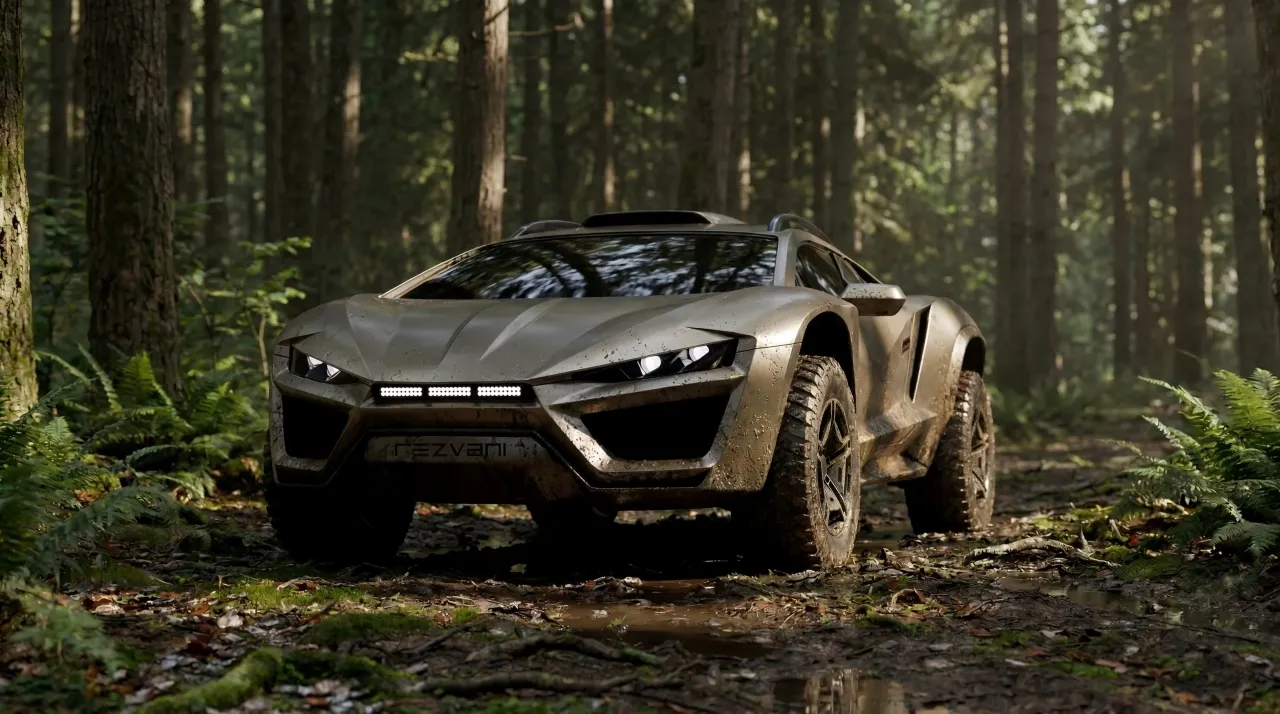
These futuristic vehicles could easily blend into any upcoming space sci‑fi film or TV show
These futuristic vehicles could easily blend into any upcoming space sci‑fi film or TV show
Lunar-inspired explorers, desert supercars and six-wheeled sanctuaries: automotive design is venturing into territory that feels distinctly off-world.
There’s a moment in every era of design when reality quietly overtakes imagination. In the 1970s, NASA prototypes looked stranger than the sci‑fi films that tried to imitate them. In the 1990s, concept cars flirted with cyberpunk long before Hollywood caught on. And now, in 2026, something uncanny is happening again: certain automotive designs are expressing vehicles that already look like they belong in space‑sci‑fi — without even trying.
Across studios from Gothenburg to Chennai to California, engineers are sketching machines for deserts, lunar regolith, and luxury sanctuaries. They’re not designing props. They’re designing the future. And yet these vehicle designs could roll straight onto the set of The Expanse, Dune: Part Two, or the next prestige sci‑fi series without a single modification.
This is the moment where real-world engineering finally catches up to off‑world storytelling.
THE COSMIC SURFER — LUNAR MOBILITY WITH A PULSE
Status: independent competition-entry concept, not an official Volvo programme.
Sampad Chaulia's Volvo Cosmic Surfer concept is the clearest example of reality drifting into sci‑fi. Its speculative gravity‑adaptive wheels — inflatable, multi‑lobed, deformable structures — compress and reshape around lunar terrain like a living organism. Instead of relying on suspension, the wheels themselves behave like compliant creatures engineered for low‑gravity traction. TrendHunter’s analysis confirms the wheel system is designed for extreme-environment mobility, reshaping on contact with uneven terrain and reducing dependence on complex suspension systems.
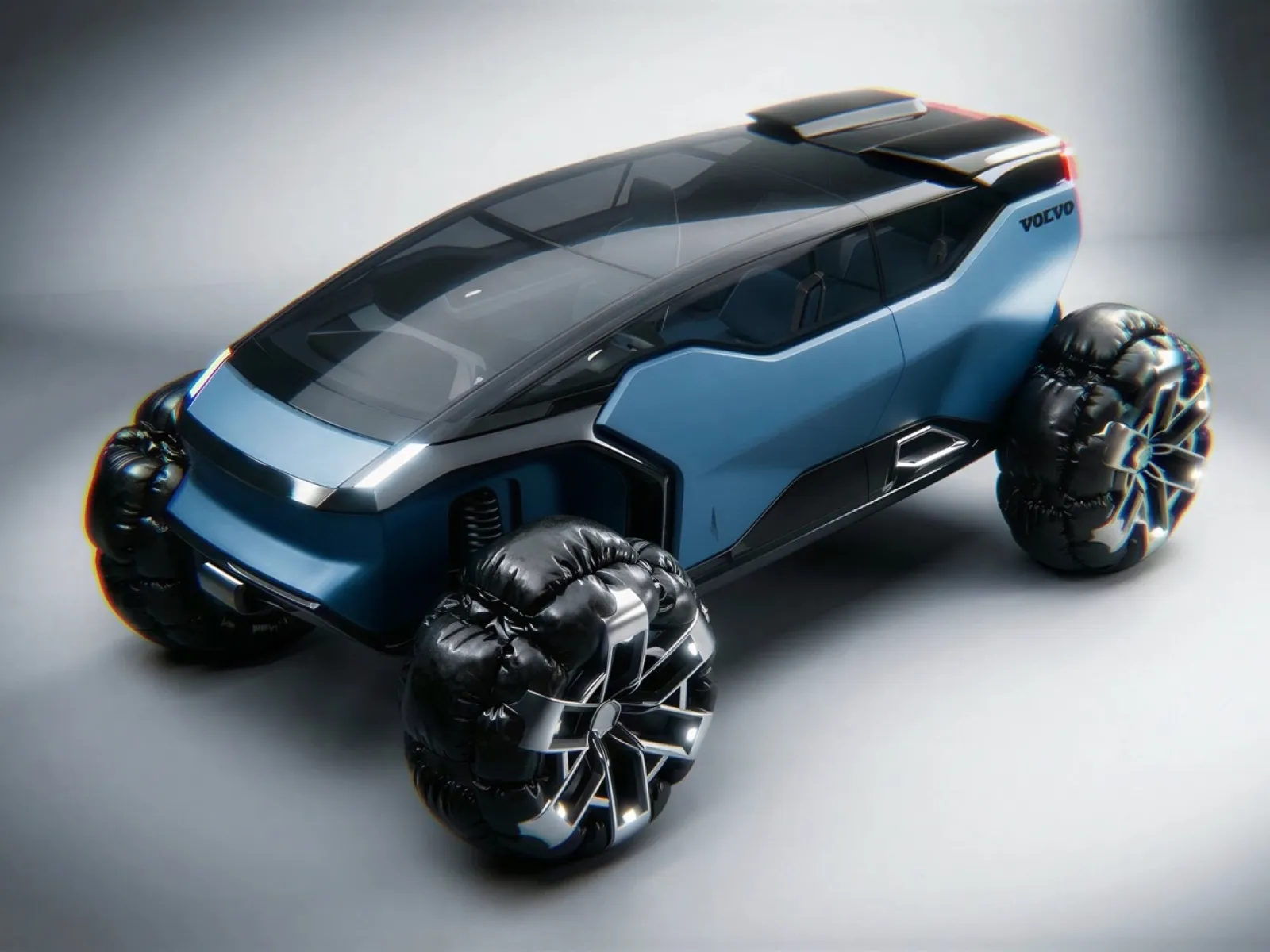
The Cosmic Surfer's steel‑blue, Scandinavian‑tech-wear silhouette and The North Face co‑branding position it as a survival‑first rover ready for off‑world terrain. Credit: Sampad Chaulia/Behance.com
The body is low, wide, and monolithic, wrapped in steel blue and co‑badged with The North Face — a collaboration that feels less like branding and more like a mission patch. Designer Sampad Chaulia frames it as a 2040 interplanetary expedition machine, built from Scandinavian minimalism and gorpcore punk aesthetics.
This isn’t a concept car. It’s a lunar rover that wandered off the Moon and into Milan that demonstrates how seriously engineers are pursuing unconventional answers.
REZVANI DUNE — A SUPERCAR MUTATED FOR HOSTILE PLANETS
Status: announced seven-example production run, with reservations offered for the 2027 model.
Where the Cosmic Surfer imagines lunar mobility, the Rezvani Dune takes an existing terrestrial platform and changes its priorities. The Rezvani Dune is a frontier‑planet scout vehicle — the kind you’d see tearing across the sands of Arrakis or carving through Martian dust storms.
Rezvani took a Lamborghini Huracán, lifted it 11.4 cm, added a VF Engineering supercharger, and created an 800‑hp V10 monster with 28 cm of ground clearance and 31‑inch mud‑terrain tires . The bodywork is almost entirely carbon fibre, flared to 2.23 meters wide, with heat extractors, roof‑mounted snorkel, recovery hooks, and LED off‑road lighting integrated into the grille and roof.
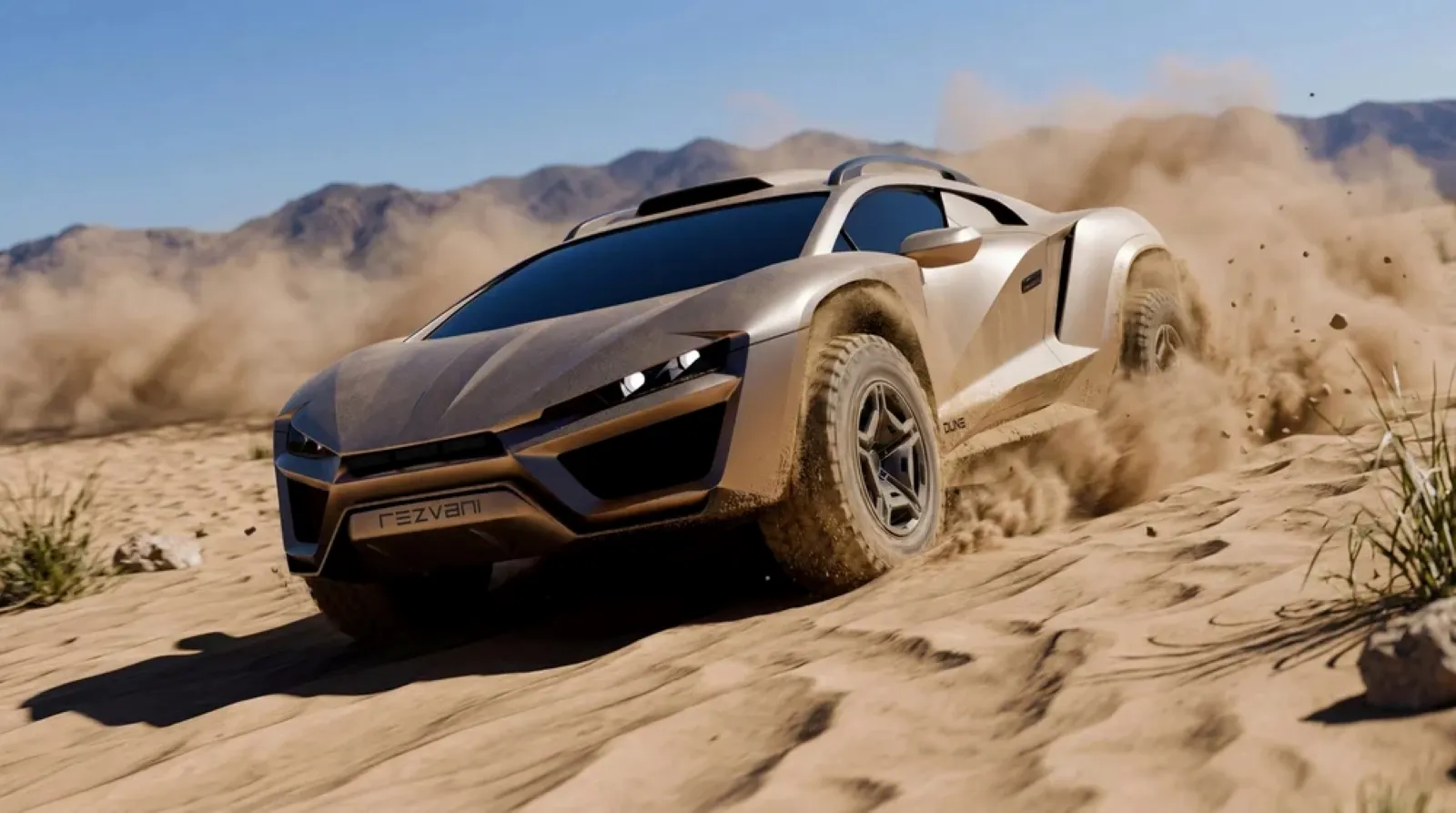
Rezvani’s Dune transforms a Lamborghini Huracán into an 800‑horsepower 4x4 machine, its carbon‑fibre exoskeleton and V10 heart make it feel like a frontier‑planet scout vehicle built for cinematic off‑world landscapes. Credit: Rezvanimotors.com
Seven will be built. No price announced. But the engineering is clear: this is a supercar built for hostile terrain, not for racetracks. Yahoo Autos confirms the Dune is a “Lambo-based supercar built for tough terrains,” with bespoke suspension, underbody protection, and proportions closer to a desert racer than an exotic .
It’s not a vehicle. It’s a character — the kind of machine sci‑fi directors write scenes around.
AUDI NUVOLARI — THE UNCANNY VALLEY OF LUXURY
Status: near-production prototype; 499 examples announced, with deliveries scheduled to begin in the first half of 2027.
Audi’s Nuvolari brings a different kind of futurism: extraordinary capability wrapped in deliberate visual restraint.
First, the chronology matters. The 2003 Nuvolari quattro concept was a front-engined grand tourer with a twin-turbo V10. The 2026 Nuvolari is a separate mid-engined hybrid supercar. They share a name, not a continuous prototype-development story. (magazine.audi.com.au)
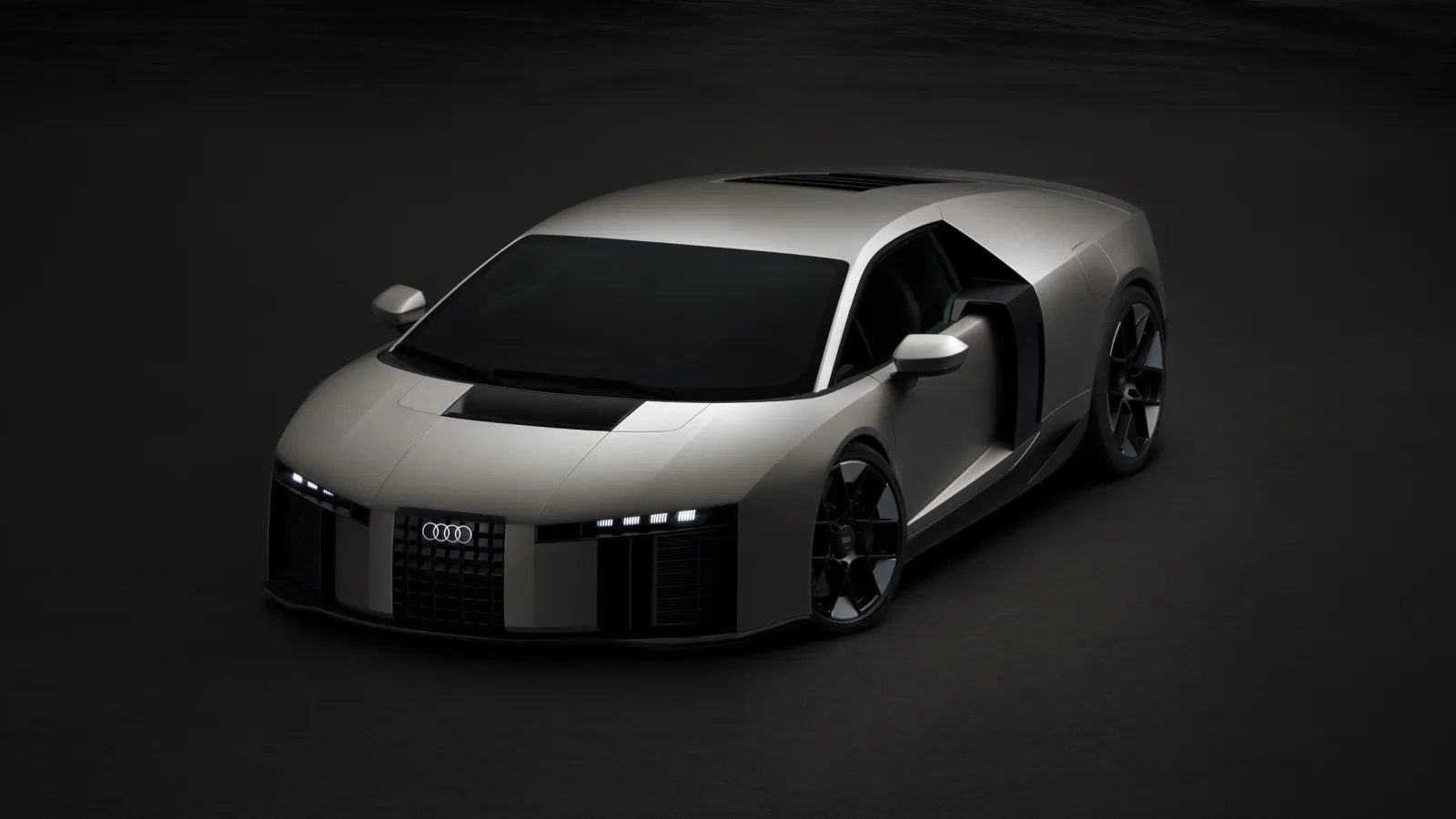
The Nuvolari's proportions and restrained surfaces give it an extraterrestrial elegance — the kind of flagship coupe that feels more at home in a sci‑fi diplomatic convoy than on Earth. Credit: Audi.com
According to Audi’s technical announcement, the new car combines a 4.0-litre twin-turbo V8 with three axial-flux electric motors, delivering 736 kW—1,001 PS. Its adaptive rear wing changes configuration to balance drag and downforce. (audi.com)
Audi also documents 405 days from the first sketch to a driveable prototype, supported by closely integrated design, aerodynamics and engineering teams. That is a striking development milestone, although not the same as completing customer production in 405 days. (audi.com)
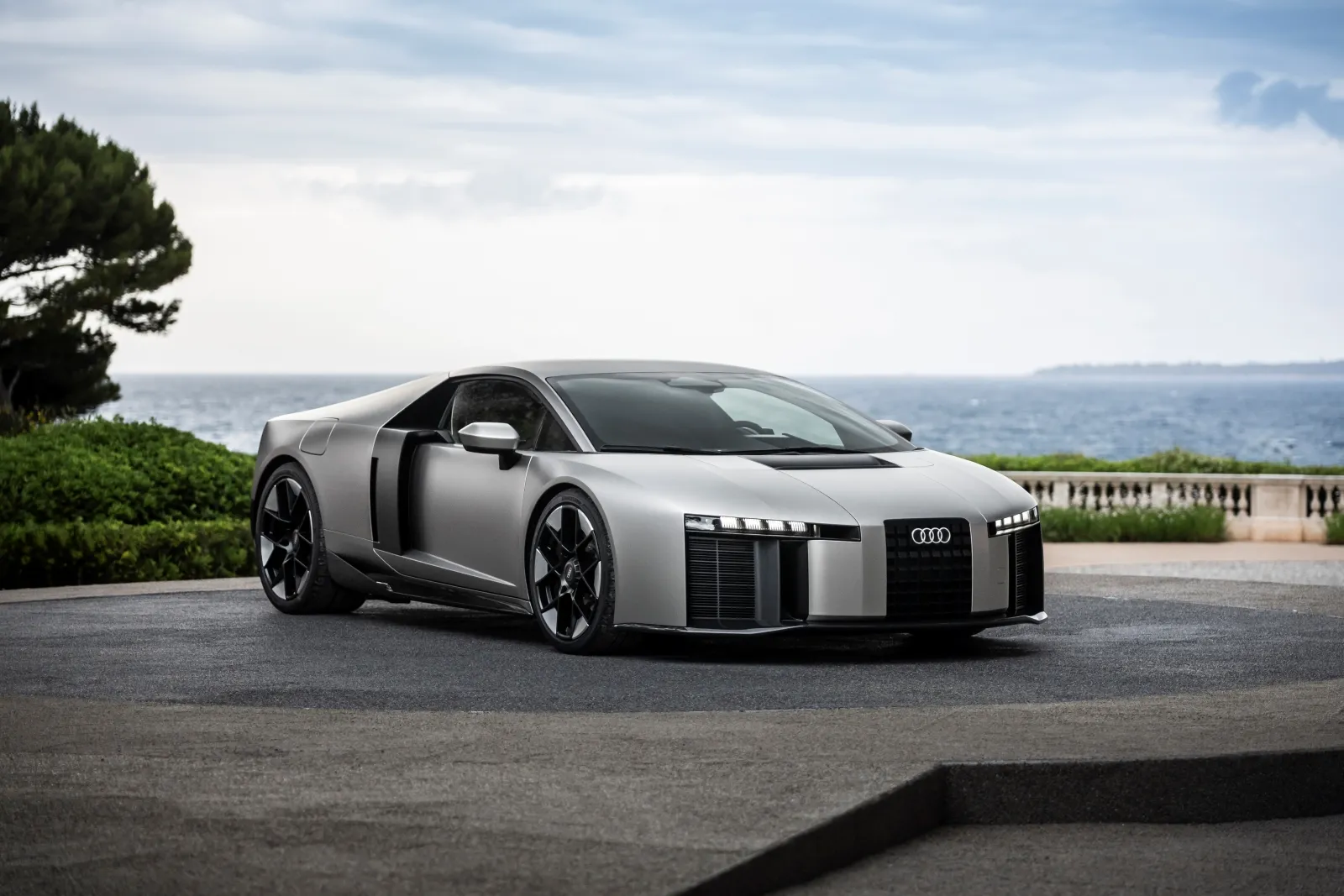
Audi’s million‑dollar Nuvolari concept enters the uncanny valley of luxury futuristic design. Credit: Audi.com
The sci-fi association comes from controlled complexity. This is not a vehicle covered in theatrical machinery. Its technology operates beneath the surfaces or emerges when required.
It feels less like a frontier workhorse than something a wealthy colony representative would select: composed at rest, with considerably more capability than its first impression suggests.
It’s the kind of vehicle you’d expect a diplomat from a distant colony to arrive in.
ROYAL ENFIELD CONTINENTAL GT STUDY — INDUSTRIAL SCI‑FI ON TWO WHEELS
Status: independent design study by Krishnakanta Saikhom.
Krishnakanta Saikhom’s Continental GT concept looks like a café racer forged inside a weapons factory. The designer literally used revolver silhouettes and handgun cross‑sections as formal references, creating a monolithic gunmetal body that encases the frame and mechanicals like a sculptural shell .
Polished cut-outs expose the air‑cooled cylinder fins like a gunsmith displaying an action mechanism. A brass medallion marks the engine compartment like a maker’s seal. A thin red LED strip traces the tail — the only modern concession in an otherwise analogue, industrial aesthetic.
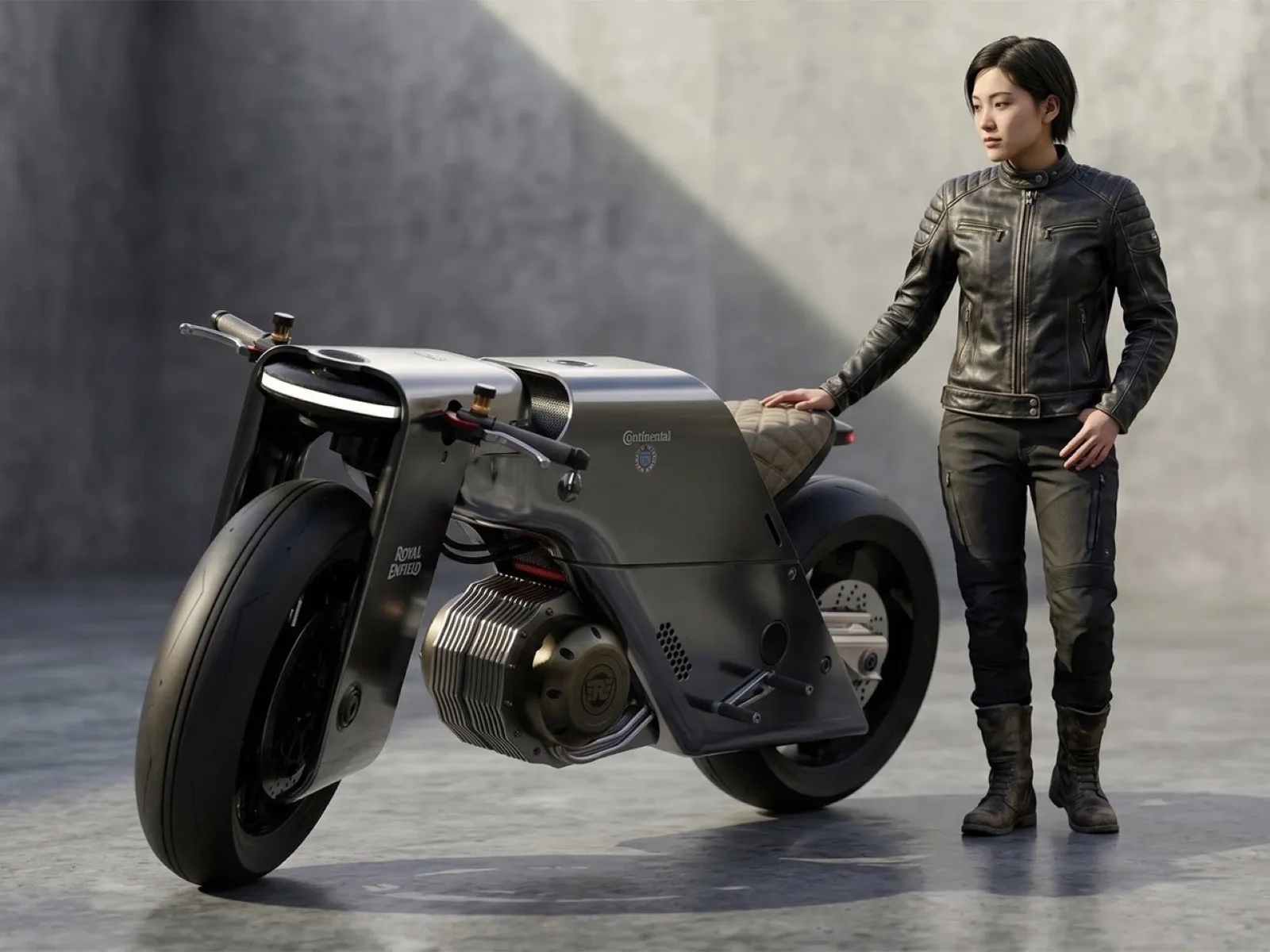
HD render of the Royal Enfield Continental GT concept motorcycle styled like a revolver, featuring gunmetal bodywork. Credit: Krishnakanta Saikhom/Behance.com
The result suggests an object manufactured by the same industrial culture that builds tools, machinery and transport. You could drop it into Andor, Blade Runner 2099, or any grounded sci‑fi world and it would feel native: it implies a world beyond the object itself.
Its contribution is design speculation, not a demonstrated official model. It asks whether a classic motorcycle can retain its identity while exchanging exposed framework for protective-looking enclosure.
The answer, visually, is surprisingly convincing.
LEXUS LS SIX‑WHEEL CONCEPT — ORBITAL LUXURY, EARTHBOUND
Status: official Lexus concept, unveiled at the Japan Mobility Show on 29 October 2025.
The Lexus LS Concept offers perhaps the most revealing idea of all: the future vehicle as a room.
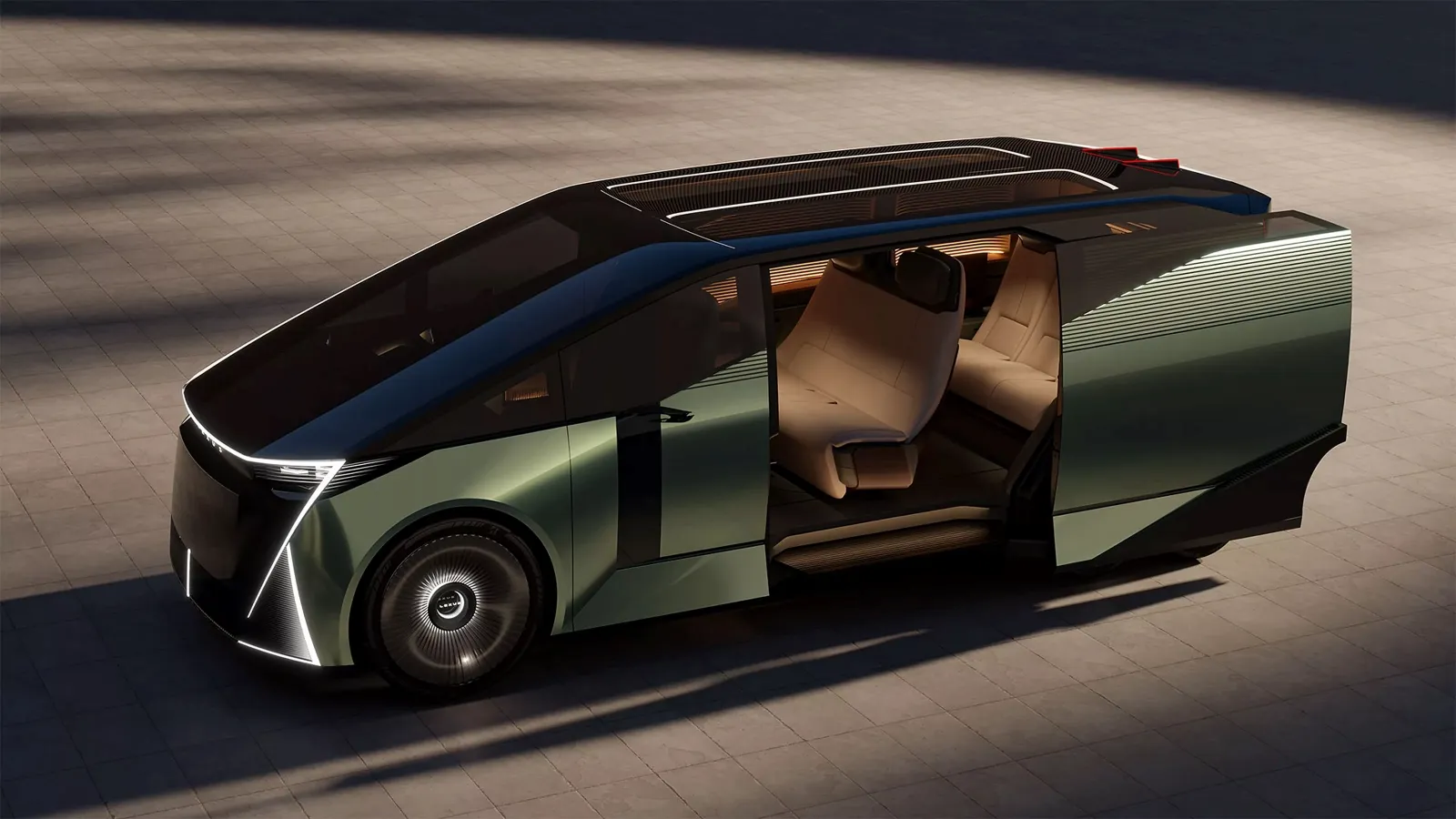
Lexus’ LS Concept redefines flagship luxury with orbital‑grade ambition. Its extended wheelbase, monolithic form, and sanctuary‑like interior evoke a VIP shuttle built for future worlds. Credit: Lexus.com
Lexus reinterprets LS as Luxury Space, proposing a six-wheeled, chauffeur-driven sanctuary. The manufacturer says the unusual layout maximises interior space and accommodates wide doors for second- and third-row passengers. Its extra wheels serve a packaging argument, not simply a styling flourish. (lexus.eu) The Lexus LS Concept is the most dramatic of the five — a six‑wheel, chauffeur‑driven luxury sanctuary that redefines what a flagship can be. Lexus confirms the “S” now stands for Space, not Sedan, signalling a shift toward vehicles designed around freedom, privacy, and personal curation.
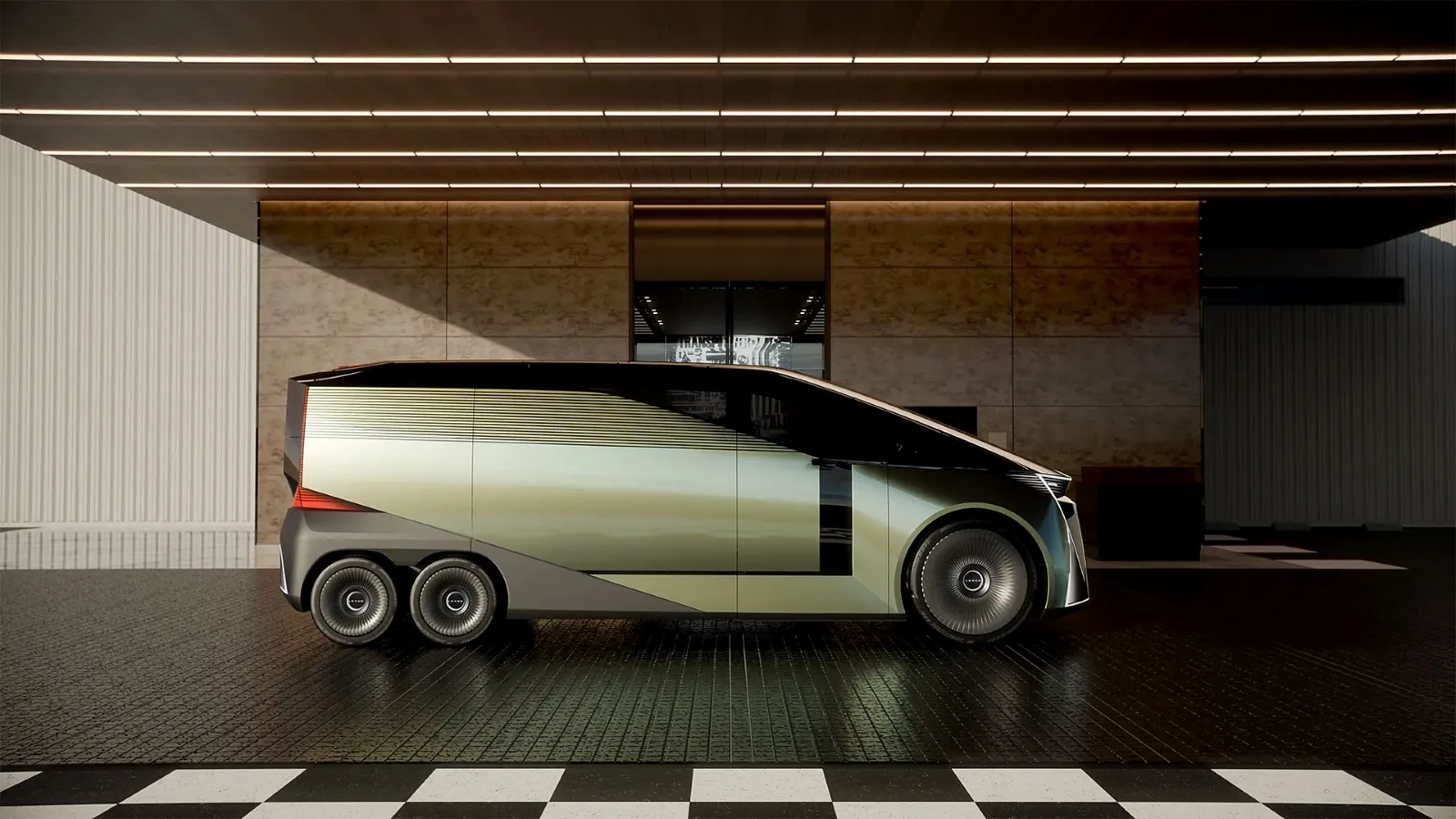
Lexus LS six‑wheel concept car displayed at Milan Design Week, featuring a monolithic body, expanded cabin volume, and futuristic luxury design language. Credit: Lexus.com
The six‑wheel layout increases interior volume, with smaller rear wheels minimizing intrusion into the floorpan. Autocar describes it as a “private sanctuary” designed to challenge perceptions of luxury, with a cavernous cabin, sliding doors, and a yoke steering device hinting at by‑wire control systems.
Yanko Design’s coverage shows the LS Concept displayed inside a rotating LED cylinder, its matte metallic body washed in shifting textures — a literal blending of vehicle and environment that feels more installation art than automotive design .
This isn’t a car. It’s a VIP shuttle for a future empire.
WHY THESE VEHICLES BELONG IN SCI‑FI
Because they’re not trying to be sci‑fi. They show how closely automotive design and science-fiction world-building can overlap.
Each implies a different future: exploration, extreme performance, discreet power, industrial survival or protected personal space. Their strongest ideas begin with purpose rather than decoration.
Cinema used to imagine the future. Now, designers are conceiving it.
The most convincing futuristic vehicle is not simply one that looks unfamiliar. It is one that makes us believe somebody, somewhere, would need it.
Lunar-inspired explorers, desert supercars and six-wheeled sanctuaries: automotive design is venturing into territory that feels distinctly off-world.
There’s a moment in every era of design when reality quietly overtakes imagination. In the 1970s, NASA prototypes looked stranger than the sci‑fi films that tried to imitate them. In the 1990s, concept cars flirted with cyberpunk long before Hollywood caught on. And now, in 2026, something uncanny is happening again: certain automotive designs are expressing vehicles that already look like they belong in space‑sci‑fi — without even trying.
Across studios from Gothenburg to Chennai to California, engineers are sketching machines for deserts, lunar regolith, and luxury sanctuaries. They’re not designing props. They’re designing the future. And yet these vehicle designs could roll straight onto the set of The Expanse, Dune: Part Two, or the next prestige sci‑fi series without a single modification.
This is the moment where real-world engineering finally catches up to off‑world storytelling.
THE COSMIC SURFER — LUNAR MOBILITY WITH A PULSE
Status: independent competition-entry concept, not an official Volvo programme.
Sampad Chaulia's Volvo Cosmic Surfer concept is the clearest example of reality drifting into sci‑fi. Its speculative gravity‑adaptive wheels — inflatable, multi‑lobed, deformable structures — compress and reshape around lunar terrain like a living organism. Instead of relying on suspension, the wheels themselves behave like compliant creatures engineered for low‑gravity traction. TrendHunter’s analysis confirms the wheel system is designed for extreme-environment mobility, reshaping on contact with uneven terrain and reducing dependence on complex suspension systems.
The Cosmic Surfer's steel‑blue, Scandinavian‑tech-wear silhouette and The North Face co‑branding position it as a survival‑first rover ready for off‑world terrain. Credit: Sampad Chaulia/Behance.com
The body is low, wide, and monolithic, wrapped in steel blue and co‑badged with The North Face — a collaboration that feels less like branding and more like a mission patch. Designer Sampad Chaulia frames it as a 2040 interplanetary expedition machine, built from Scandinavian minimalism and gorpcore punk aesthetics.
This isn’t a concept car. It’s a lunar rover that wandered off the Moon and into Milan that demonstrates how seriously engineers are pursuing unconventional answers.
REZVANI DUNE — A SUPERCAR MUTATED FOR HOSTILE PLANETS
Status: announced seven-example production run, with reservations offered for the 2027 model.
Where the Cosmic Surfer imagines lunar mobility, the Rezvani Dune takes an existing terrestrial platform and changes its priorities. The Rezvani Dune is a frontier‑planet scout vehicle — the kind you’d see tearing across the sands of Arrakis or carving through Martian dust storms.
Rezvani took a Lamborghini Huracán, lifted it 11.4 cm, added a VF Engineering supercharger, and created an 800‑hp V10 monster with 28 cm of ground clearance and 31‑inch mud‑terrain tires . The bodywork is almost entirely carbon fibre, flared to 2.23 meters wide, with heat extractors, roof‑mounted snorkel, recovery hooks, and LED off‑road lighting integrated into the grille and roof.
Rezvani’s Dune transforms a Lamborghini Huracán into an 800‑horsepower 4x4 machine, its carbon‑fibre exoskeleton and V10 heart make it feel like a frontier‑planet scout vehicle built for cinematic off‑world landscapes. Credit: Rezvanimotors.com
Seven will be built. No price announced. But the engineering is clear: this is a supercar built for hostile terrain, not for racetracks. Yahoo Autos confirms the Dune is a “Lambo-based supercar built for tough terrains,” with bespoke suspension, underbody protection, and proportions closer to a desert racer than an exotic .
It’s not a vehicle. It’s a character — the kind of machine sci‑fi directors write scenes around.
AUDI NUVOLARI — THE UNCANNY VALLEY OF LUXURY
Status: near-production prototype; 499 examples announced, with deliveries scheduled to begin in the first half of 2027.
Audi’s Nuvolari brings a different kind of futurism: extraordinary capability wrapped in deliberate visual restraint.
First, the chronology matters. The 2003 Nuvolari quattro concept was a front-engined grand tourer with a twin-turbo V10. The 2026 Nuvolari is a separate mid-engined hybrid supercar. They share a name, not a continuous prototype-development story. (magazine.audi.com.au)
The Nuvolari's proportions and restrained surfaces give it an extraterrestrial elegance — the kind of flagship coupe that feels more at home in a sci‑fi diplomatic convoy than on Earth. Credit: Audi.com
According to Audi’s technical announcement, the new car combines a 4.0-litre twin-turbo V8 with three axial-flux electric motors, delivering 736 kW—1,001 PS. Its adaptive rear wing changes configuration to balance drag and downforce. (audi.com)
Audi also documents 405 days from the first sketch to a driveable prototype, supported by closely integrated design, aerodynamics and engineering teams. That is a striking development milestone, although not the same as completing customer production in 405 days. (audi.com)
Audi’s million‑dollar Nuvolari concept enters the uncanny valley of luxury futuristic design. Credit: Audi.com
The sci-fi association comes from controlled complexity. This is not a vehicle covered in theatrical machinery. Its technology operates beneath the surfaces or emerges when required.
It feels less like a frontier workhorse than something a wealthy colony representative would select: composed at rest, with considerably more capability than its first impression suggests.
It’s the kind of vehicle you’d expect a diplomat from a distant colony to arrive in.
ROYAL ENFIELD CONTINENTAL GT STUDY — INDUSTRIAL SCI‑FI ON TWO WHEELS
Status: independent design study by Krishnakanta Saikhom.
Krishnakanta Saikhom’s Continental GT concept looks like a café racer forged inside a weapons factory. The designer literally used revolver silhouettes and handgun cross‑sections as formal references, creating a monolithic gunmetal body that encases the frame and mechanicals like a sculptural shell .
Polished cut-outs expose the air‑cooled cylinder fins like a gunsmith displaying an action mechanism. A brass medallion marks the engine compartment like a maker’s seal. A thin red LED strip traces the tail — the only modern concession in an otherwise analogue, industrial aesthetic.
HD render of the Royal Enfield Continental GT concept motorcycle styled like a revolver, featuring gunmetal bodywork. Credit: Krishnakanta Saikhom/Behance.com
The result suggests an object manufactured by the same industrial culture that builds tools, machinery and transport. You could drop it into Andor, Blade Runner 2099, or any grounded sci‑fi world and it would feel native: it implies a world beyond the object itself.
Its contribution is design speculation, not a demonstrated official model. It asks whether a classic motorcycle can retain its identity while exchanging exposed framework for protective-looking enclosure.
The answer, visually, is surprisingly convincing.
LEXUS LS SIX‑WHEEL CONCEPT — ORBITAL LUXURY, EARTHBOUND
Status: official Lexus concept, unveiled at the Japan Mobility Show on 29 October 2025.
The Lexus LS Concept offers perhaps the most revealing idea of all: the future vehicle as a room.
Lexus’ LS Concept redefines flagship luxury with orbital‑grade ambition. Its extended wheelbase, monolithic form, and sanctuary‑like interior evoke a VIP shuttle built for future worlds. Credit: Lexus.com
Lexus reinterprets LS as Luxury Space, proposing a six-wheeled, chauffeur-driven sanctuary. The manufacturer says the unusual layout maximises interior space and accommodates wide doors for second- and third-row passengers. Its extra wheels serve a packaging argument, not simply a styling flourish. (lexus.eu) The Lexus LS Concept is the most dramatic of the five — a six‑wheel, chauffeur‑driven luxury sanctuary that redefines what a flagship can be. Lexus confirms the “S” now stands for Space, not Sedan, signalling a shift toward vehicles designed around freedom, privacy, and personal curation.
Lexus LS six‑wheel concept car displayed at Milan Design Week, featuring a monolithic body, expanded cabin volume, and futuristic luxury design language. Credit: Lexus.com
The six‑wheel layout increases interior volume, with smaller rear wheels minimizing intrusion into the floorpan. Autocar describes it as a “private sanctuary” designed to challenge perceptions of luxury, with a cavernous cabin, sliding doors, and a yoke steering device hinting at by‑wire control systems.
Yanko Design’s coverage shows the LS Concept displayed inside a rotating LED cylinder, its matte metallic body washed in shifting textures — a literal blending of vehicle and environment that feels more installation art than automotive design .
This isn’t a car. It’s a VIP shuttle for a future empire.
WHY THESE VEHICLES BELONG IN SCI‑FI
Because they’re not trying to be sci‑fi. They show how closely automotive design and science-fiction world-building can overlap.
Each implies a different future: exploration, extreme performance, discreet power, industrial survival or protected personal space. Their strongest ideas begin with purpose rather than decoration.
Cinema used to imagine the future. Now, designers are conceiving it.
The most convincing futuristic vehicle is not simply one that looks unfamiliar. It is one that makes us believe somebody, somewhere, would need it.
Lunar-inspired explorers, desert supercars and six-wheeled sanctuaries: automotive design is venturing into territory that feels distinctly off-world.
There’s a moment in every era of design when reality quietly overtakes imagination. In the 1970s, NASA prototypes looked stranger than the sci‑fi films that tried to imitate them. In the 1990s, concept cars flirted with cyberpunk long before Hollywood caught on. And now, in 2026, something uncanny is happening again: certain automotive designs are expressing vehicles that already look like they belong in space‑sci‑fi — without even trying.
Across studios from Gothenburg to Chennai to California, engineers are sketching machines for deserts, lunar regolith, and luxury sanctuaries. They’re not designing props. They’re designing the future. And yet these vehicle designs could roll straight onto the set of The Expanse, Dune: Part Two, or the next prestige sci‑fi series without a single modification.
This is the moment where real-world engineering finally catches up to off‑world storytelling.
THE COSMIC SURFER — LUNAR MOBILITY WITH A PULSE
Status: independent competition-entry concept, not an official Volvo programme.
Sampad Chaulia's Volvo Cosmic Surfer concept is the clearest example of reality drifting into sci‑fi. Its speculative gravity‑adaptive wheels — inflatable, multi‑lobed, deformable structures — compress and reshape around lunar terrain like a living organism. Instead of relying on suspension, the wheels themselves behave like compliant creatures engineered for low‑gravity traction. TrendHunter’s analysis confirms the wheel system is designed for extreme-environment mobility, reshaping on contact with uneven terrain and reducing dependence on complex suspension systems.
The Cosmic Surfer's steel‑blue, Scandinavian‑tech-wear silhouette and The North Face co‑branding position it as a survival‑first rover ready for off‑world terrain. Credit: Sampad Chaulia/Behance.com
The body is low, wide, and monolithic, wrapped in steel blue and co‑badged with The North Face — a collaboration that feels less like branding and more like a mission patch. Designer Sampad Chaulia frames it as a 2040 interplanetary expedition machine, built from Scandinavian minimalism and gorpcore punk aesthetics.
This isn’t a concept car. It’s a lunar rover that wandered off the Moon and into Milan that demonstrates how seriously engineers are pursuing unconventional answers.
REZVANI DUNE — A SUPERCAR MUTATED FOR HOSTILE PLANETS
Status: announced seven-example production run, with reservations offered for the 2027 model.
Where the Cosmic Surfer imagines lunar mobility, the Rezvani Dune takes an existing terrestrial platform and changes its priorities. The Rezvani Dune is a frontier‑planet scout vehicle — the kind you’d see tearing across the sands of Arrakis or carving through Martian dust storms.
Rezvani took a Lamborghini Huracán, lifted it 11.4 cm, added a VF Engineering supercharger, and created an 800‑hp V10 monster with 28 cm of ground clearance and 31‑inch mud‑terrain tires . The bodywork is almost entirely carbon fibre, flared to 2.23 meters wide, with heat extractors, roof‑mounted snorkel, recovery hooks, and LED off‑road lighting integrated into the grille and roof.
Rezvani’s Dune transforms a Lamborghini Huracán into an 800‑horsepower 4x4 machine, its carbon‑fibre exoskeleton and V10 heart make it feel like a frontier‑planet scout vehicle built for cinematic off‑world landscapes. Credit: Rezvanimotors.com
Seven will be built. No price announced. But the engineering is clear: this is a supercar built for hostile terrain, not for racetracks. Yahoo Autos confirms the Dune is a “Lambo-based supercar built for tough terrains,” with bespoke suspension, underbody protection, and proportions closer to a desert racer than an exotic .
It’s not a vehicle. It’s a character — the kind of machine sci‑fi directors write scenes around.
AUDI NUVOLARI — THE UNCANNY VALLEY OF LUXURY
Status: near-production prototype; 499 examples announced, with deliveries scheduled to begin in the first half of 2027.
Audi’s Nuvolari brings a different kind of futurism: extraordinary capability wrapped in deliberate visual restraint.
First, the chronology matters. The 2003 Nuvolari quattro concept was a front-engined grand tourer with a twin-turbo V10. The 2026 Nuvolari is a separate mid-engined hybrid supercar. They share a name, not a continuous prototype-development story. (magazine.audi.com.au)
The Nuvolari's proportions and restrained surfaces give it an extraterrestrial elegance — the kind of flagship coupe that feels more at home in a sci‑fi diplomatic convoy than on Earth. Credit: Audi.com
According to Audi’s technical announcement, the new car combines a 4.0-litre twin-turbo V8 with three axial-flux electric motors, delivering 736 kW—1,001 PS. Its adaptive rear wing changes configuration to balance drag and downforce. (audi.com)
Audi also documents 405 days from the first sketch to a driveable prototype, supported by closely integrated design, aerodynamics and engineering teams. That is a striking development milestone, although not the same as completing customer production in 405 days. (audi.com)
Audi’s million‑dollar Nuvolari concept enters the uncanny valley of luxury futuristic design. Credit: Audi.com
The sci-fi association comes from controlled complexity. This is not a vehicle covered in theatrical machinery. Its technology operates beneath the surfaces or emerges when required.
It feels less like a frontier workhorse than something a wealthy colony representative would select: composed at rest, with considerably more capability than its first impression suggests.
It’s the kind of vehicle you’d expect a diplomat from a distant colony to arrive in.
ROYAL ENFIELD CONTINENTAL GT STUDY — INDUSTRIAL SCI‑FI ON TWO WHEELS
Status: independent design study by Krishnakanta Saikhom.
Krishnakanta Saikhom’s Continental GT concept looks like a café racer forged inside a weapons factory. The designer literally used revolver silhouettes and handgun cross‑sections as formal references, creating a monolithic gunmetal body that encases the frame and mechanicals like a sculptural shell .
Polished cut-outs expose the air‑cooled cylinder fins like a gunsmith displaying an action mechanism. A brass medallion marks the engine compartment like a maker’s seal. A thin red LED strip traces the tail — the only modern concession in an otherwise analogue, industrial aesthetic.
HD render of the Royal Enfield Continental GT concept motorcycle styled like a revolver, featuring gunmetal bodywork. Credit: Krishnakanta Saikhom/Behance.com
The result suggests an object manufactured by the same industrial culture that builds tools, machinery and transport. You could drop it into Andor, Blade Runner 2099, or any grounded sci‑fi world and it would feel native: it implies a world beyond the object itself.
Its contribution is design speculation, not a demonstrated official model. It asks whether a classic motorcycle can retain its identity while exchanging exposed framework for protective-looking enclosure.
The answer, visually, is surprisingly convincing.
LEXUS LS SIX‑WHEEL CONCEPT — ORBITAL LUXURY, EARTHBOUND
Status: official Lexus concept, unveiled at the Japan Mobility Show on 29 October 2025.
The Lexus LS Concept offers perhaps the most revealing idea of all: the future vehicle as a room.
Lexus’ LS Concept redefines flagship luxury with orbital‑grade ambition. Its extended wheelbase, monolithic form, and sanctuary‑like interior evoke a VIP shuttle built for future worlds. Credit: Lexus.com
Lexus reinterprets LS as Luxury Space, proposing a six-wheeled, chauffeur-driven sanctuary. The manufacturer says the unusual layout maximises interior space and accommodates wide doors for second- and third-row passengers. Its extra wheels serve a packaging argument, not simply a styling flourish. (lexus.eu) The Lexus LS Concept is the most dramatic of the five — a six‑wheel, chauffeur‑driven luxury sanctuary that redefines what a flagship can be. Lexus confirms the “S” now stands for Space, not Sedan, signalling a shift toward vehicles designed around freedom, privacy, and personal curation.
Lexus LS six‑wheel concept car displayed at Milan Design Week, featuring a monolithic body, expanded cabin volume, and futuristic luxury design language. Credit: Lexus.com
The six‑wheel layout increases interior volume, with smaller rear wheels minimizing intrusion into the floorpan. Autocar describes it as a “private sanctuary” designed to challenge perceptions of luxury, with a cavernous cabin, sliding doors, and a yoke steering device hinting at by‑wire control systems.
Yanko Design’s coverage shows the LS Concept displayed inside a rotating LED cylinder, its matte metallic body washed in shifting textures — a literal blending of vehicle and environment that feels more installation art than automotive design .
This isn’t a car. It’s a VIP shuttle for a future empire.
WHY THESE VEHICLES BELONG IN SCI‑FI
Because they’re not trying to be sci‑fi. They show how closely automotive design and science-fiction world-building can overlap.
Each implies a different future: exploration, extreme performance, discreet power, industrial survival or protected personal space. Their strongest ideas begin with purpose rather than decoration.
Cinema used to imagine the future. Now, designers are conceiving it.
The most convincing futuristic vehicle is not simply one that looks unfamiliar. It is one that makes us believe somebody, somewhere, would need it.
Image Gallery
Comments
Please be kind and considerate. Any abusive or offensive comments will be sent out the airlock! Thank You.
Please be kind and considerate. Any abusive or offensive comments will be sent out the airlock! Thank You.


Join the SciNexic Crew
Related Posts

Share on Instagram
Share on Instagram
Banner Image - Rezvani Dune promo image - www.Rezvanimotors.com - Copyright: Rezvani Motors
Main Article - All images and media are the property of their respective owners.